Reviewing the Major Macro Variables

By Paul Hoffmeister, Chief Economist

·      Here, in our latest monthly letter, we discuss US-China Trade, Fed and ECB policy, Brexit, the Hong Kong protests, and the 2020 elections. Given the increasingly weak global economy, the possibility grows that each could make or break the next year.

·      We believe President Trump’s negotiating strategy is becoming increasingly clear, and there are more levers he can pull to pressure China to concede to US demands. Given how much further Trump can go as well as the weak Chinese economy today, the odds are rising in our view that Chinese officials will compromise on at least some major demands in the coming year. A comprehensive deal, however, is a long shot – as that arguably would entail a wholesale reformation of the Chinese economic system.

·      Furthermore, we expect the Federal Reserve and European Central Bank to continue moving dovishly, and if conditions deteriorate further, they will need to do so in a big way – such as a 50 basis point cut at an upcoming FOMC meeting.

·      Prime Minister Boris Johnson shocked the world with his political maneuverings recently, and the probability of Brexit by the end of October has jumped significantly.

·      Hong Kong protests are a serious danger to the legitimacy of the Chinese government and the confidence in Hong Kong as an international financial center – if not during the near-term, then during the long-term.

·      Elizabeth Warren is arguably the front-runner for the Democratic nomination. Managed health care stocks have been notably weak during the last month.

 US-China Trade: In our view, negative news on the US-China trade front has sparked the two meaningful sell-offs of 2019. Of course, on Sunday May 5, President Trump accused Chinese officials over Twitter of renegotiating the terms of what appeared to be a tentative agreement, and so he promised tariff increases by the end of that week.[i] Then on August 1, Trump announced, again via Twitter, additional 10% tariffs on $300 billion of Chinese imports.[ii] In each instance, the new information seemed to indicate that US-China trade negotiations were devolving substantially.

This is reportedly supported by recent comments from top officials in both camps. In an interview on CNN last weekend, National Economic Council Director Larry Kudlow said he couldn’t promise a finalized trade deal with China by the November 2020 election.[iii] And according to Bloomberg this week, Chinese officials have said only a few negotiators see a deal as actually possible before then, “in part because it’s dangerous for any official to advise President Xi Jinping to sign a deal that Trump may eventually break”.[iv]

Screen Shot 2019-09-03 at 2.28.00 PM.png

In sum, the outlook for a resolution to the US-China trade dispute is very cloudy, and a slew of tit-for-tat tariffs have already been applied by both countries, and there are many more scheduled by year-end.

President Trump continues down two parallel paths, as we see it. The first path is the effort to reach a comprehensive agreement that addresses American grievances related to forced technology transfers, IP theft, fair market access, and Chinese state subsidies to domestic businesses. Assumedly, a partial deal would be met with the removal of some, but not all tariffs. The second path is the formation of a US trading sphere so as to create two international trading spheres with the US and China at the center of each.

Today, the prospects for a comprehensive trade deal with China are poor, while two distinct international trading spheres appear to be forming.

The Trump Administration has agreed to a revised US-Korea free trade agreement (September 2018) and the new US-Mexico-Canada Agreement or “USMCA” (June 2019), which replaced NAFTA. Furthermore, the White House is working on new trade agreements with Japan, the European Union, and the United Kingdom.

It appears that a deal with Japan is getting closer to being sealed as President Trump and Prime Minister Shinzo Abe agreed to “core principles” at the recent G7 meeting. It’s possible that the deal will be finalized within the next 1-2 months. At the same time, Trump and Prime Minister Boris Johnson have spoken positively about a major US-UK deal if Brexit happens. As for a US-EU deal, Trump struck an upbeat tone at the G7 meeting, saying “We’re very close to maybe making a deal with the EU because they don’t want tariffs.”[v] With this new US-centric trading sphere taking shape, it may explain why Trump seemed so upbeat about the G7 meeting.

Given the current circumstance, we expect President Trump to keep up the significant pressure on China to force into a more reciprocal trading relationship, and the path is unlikely to be smooth.

First, Trump could still apply more economic pressure possibly by raising tariffs even higher, utilizing the Emergency Economic Powers Act of 1977 to force US companies to divest from China, or even sanctioning Chinese companies or officials suspected of human rights violations.

Secondly, as the complex negotiations continue, it’s likely we’ll hear more mixed signals from President Trump. Asked by reporters at the G7 summit about his seemingly back-and-forth and changing statements on subjects such as President Xi and Iran, the President said, “Sorry, it’s the way I negotiate… It’s done very well for me over the years, and it’s doing even better for the country.”[vi]

Bottom Line: We believe President Trump’s negotiating strategy is becoming increasingly clear, and there are more levers he can pull to pressure China to concede to US demands. Given how much further Trump can go as well as the weak Chinese economy today, the odds are rising in our view that Chinese officials will compromise on at least some major demands in the coming year. A comprehensive deal, however, is still a long shot – as that arguably would entail a wholesale reformation of the Chinese economic system.

 Fed Policy: There are three more FOMC meetings before year-end, with the next one scheduled for September 17-18. At that meeting, federal funds futures are currently implying a nearly 96% probability of a 25 basis point rate cut, and 4% probability of a 50 basis point cut -- according to the CME Fedwatch Tool.

Arguably, the Fed must cut interest rates aggressively, and soon. The Fed is hostage to the market, trade negotiations, and other major macro uncertainties in the world today that are inhibiting risk-taking and production and thus slowing global economic activity. The inverted Treasury curve is another indication of the significant pressure on the Fed to cut interest rates. For example, the 3-month/2-year Treasury spread is approximately -47 basis points today, according to the St. Louis Federal Reserve. From our perspective, this implies that the market believes the funds rate is at least 50 basis points too high at the moment.

Is the inverted yield curve a signal of a looming recession? We believe that it’s an ominous signal, given its track record for preceding many recessions, and an indication of central bank error. But recession isn’t guaranteed. It’s still possible that aggressive rate cuts by the Fed and more clarity and resolution to many other macro uncertainty could re-ignite animal spirits and keep the United States from recession.

Notably, former New York Federal Reserve President William Dudley penned a highly controversial Bloomberg oped on August 27, in which he expressed a desire for the Fed to withhold interest rate reductions in order to not “bail out an administration that keeps making bad choices on trade policy”.[vii] It also appeared that Dudley went even further to suggest that the Fed pursue monetary policy into the November 2020 elections in a manner that prevented President Trump’s reelection.

But Dudley’s oped may backfire. It seems that the popular response to his oped has been critical, and ironically, may in fact turn the tables and force the Fed to prove that it isn’t acting in an “anti-Trump” manner by withholding rate cuts, but is purely economically motivated and therefore will reduce interest rates aggressively during the coming months. 

ECB Policy: At its next monetary policy meeting on September 12, it looks like the ECB will be meaningfully dovish, at least according to Olli Rehn, a member of the ECB’s rate-setting committee and governor of Finland’s central bank.

On Thursday, August 15, Rehn said, “When you’re working with financial markets, it’s often better to overshoot than undershoot, and better to have a very strong package of policy measures than to tinker.”[viii]

We believe the ECB will lower its benchmark overnight rate by 10-20 basis points from negative 0.40% currently; announce new bond purchases (“quantitative easing”); and favorably adjust loan terms for EU banks.

As we indicated last month, the sharpest slowdown in growth globally may be occurring in Europe. It looks like the ECB is preparing to pull out the figurative monetary bazooka in a few weeks.

Bottom Line: We expect the Federal Reserve and European Central Bank to continue moving dovishly, and if conditions deteriorate further, they will need to do so in a big way – such as a 50 basis point cut at an upcoming FOMC meeting.

 Brexit: Prime Minister Boris Johnson has famously said that he’ll achieve Brexit by the October 31 deadline “do or die”. To that end, he shocked the world on August 28 by announcing that his Parliament will be suspended sometime between September 9-12, thanks to Queen Elizabeth II’s approval. Parliament will recommence after the Queen’s speech on October 14.[ix] This will give anti-Brexiters in the legislature little time to stop a no-deal Brexit by its lawfully mandated deadline.

Interestingly, the EU Council Meeting is scheduled to take place October 17-18. It appears that there are two possible scenarios emerging here: 1) if Johnson returns with a new Brexit deal, then he’ll hope to ram it through Parliament with less than two weeks to the deadline; or 2) if Johnson does not return with a new deal, then a no-deal Brexit may automatically occur by the deadline.

In sum, the probability of Brexit has increased substantially thanks to Johnson’s crafty political maneuvering. On August 28, the Predicit market for Brexit occurring by November 1 was 58 cents on the dollar; whereas the day before, the contract traded at 48 cents.[x]

Screen Shot 2019-09-03 at 2.29.06 PM.png

Importantly, to mitigate market volatility and economic uncertainty that could erupt with the UK’s exit from the European Union, Johnson should figure out how to quickly pass pro-growth policies, including business-friendly tax cuts and a new trade deal with the United States – both of which he has previously endorsed.

According to the Financial Times, Finance Minister Sajid Javid said two weeks ago, in his first interview since assuming his new role[xi], that he wanted to see lower taxes, but he did not commit to delivering the Johnson government’s budget proposal before Brexit day (October 31). Arguably, the Johnson government should be more aggressive here. One idea that’s been floated is lowering the UK’s corporate tax rate to as low as Ireland’s. This could be highly beneficial for the economy and markets. But, unfortunately, we haven’t heard much about it during the last month.

As for a US-UK trade agreement, at the recent G7 meeting, President Trump reiterated his desire and plan for a deal, saying “We’re going to do a very big trade deal – bigger than we’ve ever had with the UK.”[xii]

Bottom Line: Brexit by the end of October 31 is now our base case scenario, given Boris Johnson’s latest parliamentary maneuverings. We want to see a pro-growth plan, such as tax cuts and big trade agreements, implemented at the same time as Brexit transpires.

 Hong Kong Protests: The protests in Hong Kong since early June continue. And, in the latest turn of events, the Xinhua news agency reported yesterday that the People’s Liberation Army (PLA) had sent a new batch of troops and equipment -- including personnel carriers, trucks and a small naval vessel – into Hong Kong.[xiii] Although this rotation of troops has been reported to be routine, the potential of a government crackdown is seemingly growing, raising the risks of unintended consequences for the Asian financial hub and the region at large.

Bottom Line: The unrest in Hong Kong is a major risk to the Communist Party’s grip on power and the region’s economies – if not during the near-term, then during the long-term.

 2020 Elections: Elizabeth Warren’s prospects for becoming the Democratic presidential nominee seem to be growing. In fact, she could be considered the front-runner today.

On Predictit, the contract for her to be the nominee has risen to 34 cents on the dollar, compared to 22 cents on July 30. Bernie Sanders has risen to 16 cents from 13 during that time; while Kamala Harris has fallen to 10 from 24. The contract for former Vice President Joe Biden is trading roughly flat, around 26-27 cents.[xiv]

Given these betting market indications, it seems that with Warren and Sanders, the progressive wing of the Democratic Party is ascendant. And notably, with Medicare for All being a hot topic in the Democratic primaries, managed health care stocks have been especially weak during the last month. According to CNBC, the S&P 500 Managed Health Care Index fell 11.1% between July 31 and its low on August 27.

This sector may be a clear way to play bets on whether a Republican or Democrat wins the White House in 2020. We still believe, as we explained in April, that changes in American health care policy are likely in coming years, but a lot more needs to happen politically before a wholesale restructuring of the system occurs.

Bottom Line: Elizabeth Warren is arguably the front-runner to compete against President Trump for the White House in 2020. Her recent strength, as well as Bernie Sanders’s, may have spooked managed health care stocks in August.

PKH Headshot - Sep 2015.jpg

Paul Hoffmeister is chief economist and portfolio manager at Camelot Portfolios, managing partner of Camelot Event-Driven Advisors, and co-portfolio manager of Camelot Event-Driven Fund (tickers: EVDIX, EVDAX).

 *******

Disclosures:

•       Past performance may not be indicative of future results. Therefore, no current or prospective client should assume that the future performance of any specific investment, investment strategy (including the investments and/or investment strategies recommended by the adviser), will be profitable or equal to past performance levels.

•       This material is intended to be educational in nature, and not as a recommendation of any particular strategy, approach, product or concept for any particular advisor or client.  These materials are not intended as any form of substitute for individualized investment advice.  The discussion is general in nature, and therefore not intended to recommend or endorse any asset class, security, or technical aspect of any security for the purpose of allowing a reader to use the approach on their own.  Before participating in any investment program or making any investment, clients as well as all other readers are encouraged to consult with their own professional advisers, including investment advisers and tax advisors.  Camelot Portfolios LLC can assist in determining a suitable investment approach for a given individual, which may or may not closely resemble the strategies outlined herein.

•       Any charts, graphs, or visual aids presented herein are intended to demonstrate concepts more fully discussed in the text of this brochure, and which cannot be fully explained without the assistance of a professional from Camelot Portfolios LLC.  Readers should not in any way interpret these visual aids as a device with which to ascertain investment decisions or an investment approach.  Only your professional adviser should interpret this information.

•       Some information in this presentation is gleaned from third party sources, and while believed to be reliable, is not independently verified.

A901


[i] “Trump Says He Will Increase Tariffs on Chinese Goods on Friday as He Complains about Pace of Trade Talks”, by David Lynch, Damian Paletta and Robert Costa, May 5, 2019, Washington Post.

[ii][ii] “Trump Says US Will Impose Additional 10% Tariffs on Another $300 Billion of Chinese Goods Starting Sept. 1”, by Yun Li, August 1, 2019, CNBC.

[iii] “Kudlow Can’t Promise China Trade Deal by November 2020, But Says Big Announcement Coming”, by Nick Givas, August 25, 2019, Fox News.

[iv] “China Prepares for the Worst on Trade War After Trump’s Flip-Flops”, by Peter Martin, Kevin Hamlin, Miao Han, Dandan Li, Steven Yang and Ying Tian, August 27, 2019, Bloomberg News.

[v] “Trump Sees Possible US-EU Trade Deal That Would Avert Car Tariffs”, by Jeff Masonl and Paul Carrel, August 26, 2019, Reuters.

[vi] “’Sorry, it’s the way I negotiate’: Trump Confounds the World at Wild G-7”, by Gabby Orr, August 26, 2019, Politico.

[vii] “The Fed Shouldn’t Enable Donald Trump”, by William Dudley, August 27, 2019, Bloomberg.

[viii] “ECB Has Big Bazooka Primed for September, Top Official Says”, by Tom Fairless, August 15, 2019, Wall Street Journal.

[ix] “Boris Johnson Just Took a Huge Step to Ensure Brexit Happens on October 31”, by Matt Wells, August 28, 2019, CNN.

[x] Source: Predictit.org

[xi] Sajid Javid Promises a Simpler Tax Regime”, by Sebastian Payne, August 17, 2019, Financial Times.

[xii] “After Brexit, a U.S. Trade Deal”, Wall Street Journal Editorial, August 28, 2019, Wall Street Journal.

[xiii] “China Sends Fresh Troops into Hong Kong as Military Pledges to Protect ‘National Sovereignty’”, Weizhen Tan, August 29, 2019, CNBC.

[xiv] Source: Predictit.org
Out of an Abundance of Caution

By Paul Hoffmeister, Chief Economist

·      Our general view from early July remains the same: “Until we see a more clarified economic outlook, risk management should be a growing priority in coming months. Arguably, this is the kind of environment where one should seek to secure and protect investment gains.”

·      It appears to be decades since this market has seen so many different, major macrovariables in play at the same time; each of which could impact asset prices dramatically.

·      As we see it: the global economy is slowing significantly, especially in the manufacturing sector; Brexit is likely to occur this year, deal or no deal (otherwise Boris Johnson risks the same political fate as Theresa May); US-China trade negotiations are unlikely to produce a comprehensive agreement anytime soon; and civil unrest in Hong Kong could spark a severe crackdown from Beijing.

·      The scariest chart today is possibly the US Treasury curve. If Fed rate cuts were going to more than offset today’s market risks, then why isn’t the Treasury curve steepening? Why is the curve inverting even more since the last FOMC meeting? The Treasury market appears to be signaling dark undercurrents to this market.

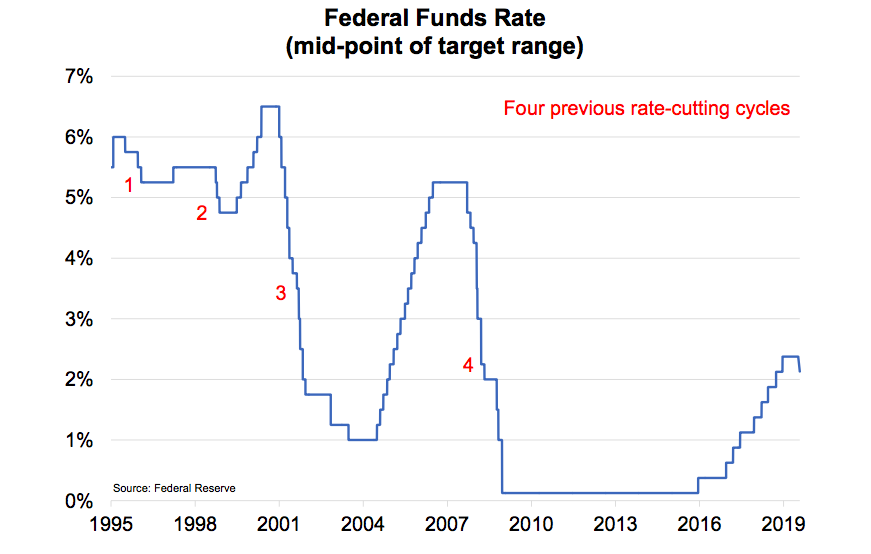
 On Wednesday, July 31st the FOMC cut its target range for the federal funds rate by a quarter point to 2.00-2.25% -- the first rate reduction since 2008. In the post meeting press conference, Chairman Powell said that he didn’t view this as “the beginning of a long series of rate cuts”.[i] He added, “You would do that if you saw real economic weakness… That’s not what we’re seeing.” As such, Powell framed the rate cut as a “mid-cycle adjustment.” Clearly, equity markets were disappointed with the decision, as the S&P 500 fell 1.1% for the day.[ii]

The next day, many US equity indices were up significantly but quickly sold off following a tweet by President Trump announcing additional sanctions on Chinese imports, which will begin in September. Later in the day, Trump said about Chinese leaders, “If they don’t want to trade with us anymore, that would be fine with me.”[iii]

The abrupt equity weakness in recent days brings to an end weeks of seemingly boring, upward drifting equity markets. Such is the market these days. It’s difficult to be wildly bullish (many things could easily pop up and catch you wrong-footed), and difficult to be severely bearish (the Fed-induced rally this year has made that clear).

Screen Shot 2019-08-12 at 11.36.55 AM.png

Ironically, though, when one looks at the performance (not including dividends) of theS&P 500 during the months following the initial rate cuts of the four previous rate-cutting cycles (which began in July 1995, September 1998, January 2001 and September 2007), the Index rallied 20% to 25% during the 12 months after the start of the 1995 and 1998 rate-cutting cycles, and sold off 10% to 15% after the start of the 2001 and 2007 cycles. Arguably, if history is any guide, one could easily get taken to the cleaners if they aggressively play this market incorrectly here.

Screen Shot 2019-08-12 at 11.37.16 AM.png

So how does one position themselves? I would recommend caution.

Contrary to Jerome Powell’s perspective, the global economy appears to be meaningfully slowing. According to Markit Manufacturing PMI data, 27 out of 28 countries had manufacturing PMI’s of greater than 50 in January 2018 – meaning the manufacturing sectors were growing in nearly all the countries that Markit monitors. In January 2019, 18 out of 28 countries showed manufacturing growth (PMI’s greater than 50). Unfortunately, as of June 2019, just 11 countries were showing manufacturing growth. The global slowdown is increasingly real.

 Even in the United States, which has enjoyed major corporate tax cuts and deregulation, the Markit manufacturing PMI for July registered 50.4, indicating that domestic manufacturing is on the verge of contraction. This is down from a high of 56.5 in April 2018.

 Most worrisome to us, though, is Germany’s Markit/BME manufacturing PMI, which registered 43.2 in July. This is down sharply from 63.3 in December 2017. As we assess the economic data globally, the slowdown may be sharpest in Europe.

 Arguably, it has been decades since this market has seen so many different, major macrovariables in play at the same time; each of which could impact asset prices dramatically.

 For example: the global economy is slowing (what will be the impact to levered industries highly exposed to growth, such as banks?); the UK’s new Prime Minister Boris Johnson is promising Brexit by October 31st, deal or no deal (we believe him and expect tough talk, otherwise Nigel Farage’s new, highly successful Brexit Party will look to gain even more political ground); US-China trade appears to be more about global geopolitical competition and supremacy rather than a mere trade disagreement (can China realistically make wholesale changes to its economic model, quickly and without serious unintended consequences?); and civil unrest in Hong Kong doesn’t seem to be dying down (will Beijing send in PLA troops to quell the demonstrations?).

 Even more, after having reportedly ruled out forex intervention to weaken the dollar, President Trump told reporters recently that he hadn’t ruled anything out.[iv] Uncertainty and volatility in the world’s reserve currency could have grave, far-reaching consequences. So far, we interpret the leak about dollar intervention and devaluation as a negotiating tool in the US-China trade talks. But it raises another substantial risk to the market today.

 Clearly to an optimist or equity market bull, these risks and uncertainties could be tinder to ignite another major rally. If these risks fade or get resolved, equities could arguably climb much higher.

 And importantly, not all is bad. At least the Federal Reserve is no longer purposely looking to slow economic growth with higher interest rates. And one notable uncertainty was clarified during the last month: impeachment risk. As we’ve suggested to clients, it appears that the Clinton impeachment hearings and related events in 1998 negatively impacted credit markets. Consequently, we believed it was possible that the pursuit of a Trump impeachment could have a similar, negative effect today.

 Interestingly, on July 24th, the day of Special Counsel Mueller’s testimony before Congress, the spread between Moody’s Baa and Aaa-rated corporate bonds narrowed 9 basis points from 100 to 91 – an usually large one day move. It appears the Mueller testimony has stalled the push for impeachment. As former counsel to the Senate Judiciary Committee, Gregg Nunziata, told Wall Street Journal editor Paul Gigot recently: “…pro-impeachment Democrats hoped that this hearing would kind of fan the flames of impeachment and create a national demand for impeachment over the summer. And it’s clear that far from fanning the flames, this is a wet blanket… So I think impeachment has become less likely, and I think we’re more likely to have Donald Trump face the voters in November [2020]. And the voters will render their judgment...”[v]

 Notwithstanding, the multitude of market risks or uncertainties appear to be creating dark undercurrents. The scariest chart today is possibly the US Treasury curve, which inverted even more during the days following the July 31st rate cut announcement and August 1st tariff news.

Screen Shot 2019-08-12 at 11.38.35 AM.png

According to the St. Louis Federal Reserve, the spread between 10-year and 3-month Treasuries was -2 basis points on Tuesday July 30, 2019. As of Friday, August 2, the spread trades around -19.

 If Fed rate cuts were going to more than offset today’s market risks, then why isn’t the Treasury curve steepening? Why is the curve inverting even more?

 As we see it, the current market environment warrants an abundance of caution. Brexit looms, US-China trade negotiations are devolving, global growth is slowing significantly. And perhaps the current Fed policy approach isn’t enough. Most likely, the Fed will align with the market, and the recent rate cut will no longer look like a “mid-cycle policy adjustment”. As such, we are likely to see more disappointing economic data and more volatility in risk asset prices.

*******

Disclosures:

•       Past performance may not be indicative of future results. Therefore, no current or prospective client should assume that the future performance of any specific investment, investment strategy (including the investments and/or investment strategies recommended by the adviser), will be profitable or equal to past performance levels.

•       This material is intended to be educational in nature, and not as a recommendation of any particular strategy, approach, product or concept for any particular advisor or client.  These materials are not intended as any form of substitute for individualized investment advice.  The discussion is general in nature, and therefore not intended to recommend or endorse any asset class, security, or technical aspect of any security for the purpose of allowing a reader to use the approach on their own.  Before participating in any investment program or making any investment, clients as well as all other readers are encouraged to consult with their own professional advisers, including investment advisers and tax advisors.  Camelot Portfolios LLC can assist in determining a suitable investment approach for a given individual, which may or may not closely resemble the strategies outlined herein.

•       Any charts, graphs, or visual aids presented herein are intended to demonstrate concepts more fully discussed in the text of this brochure, and which cannot be fully explained without the assistance of a professional from Camelot Portfolios LLC.  Readers should not in any way interpret these visual aids as a device with which to ascertain investment decisions or an investment approach.  Only your professional adviser should interpret this information.

•       Some information in this presentation is gleaned from third party sources, and while believed to be reliable, is not independently verified. A899

PKH Headshot - Sep 2015.jpg

Paul Hoffmeister is chief economist and portfolio manager at Camelot Portfolios, managing partner of Camelot Event-Driven Advisors, and co-portfolio manager of Camelot Event-Driven Fund (tickers: EVDIX, EVDAX).


[i] “Fed Cuts Rates by a Quarter Point in Precautionary Move”, by Nick Timiraos, July 31, 2019, Wall Street Journal.

[ii] Ibid.

[iii] “Trump Says It’s “Fine with Me” If China Doesn’t Want to Trade With the U.S.”, August 1, 2019, CBS News.

[iv] “Trump Suggests He Could Take Steps to Weaken U.S. Dollar, Fueling Confusion”, by Damian Paletta, July 26, 2019, Washington Post.

[v] Interview, “Wall Street Journal Editorial Report”, July 28, 2019, Wall Street Journal.

June: A Confluence of Positives

By Paul Hoffmeister, Chief Economist

·      During the last month, we’ve seen a confluence of positives in some of the major macro variables: Fed policy, trade and Brexit.

·      To us, the latest macro developments are very encouraging. But the equity market outlook remains tricky, and we do not believe it’s a one-way ticket up in equities for the third and fourth quarters.

·      My biggest concern at the moment is the slowing global economy, which is permeating into the United States.

·      Until we see a more clarified economic outlook, risk management should be a growing priority in coming months. Arguably, this is the kind of environment where one should seek to secure and protect investment gains.

During the last month, we’ve seen a confluence of positives in some of the major macro variables. Most notably, Chairman Powell said on June 4th that the FOMC was prepared to act in response to the economic outlook, including the trade disputes with China and Mexico.[i] His comments suggested that interest rate cuts were on the horizon, sparking a 2.1% rally in the S&P 500 for the day.[ii] The rally marked the beginning of the recent turnaround in equities after the weakness we saw in May. 

The next FOMC meeting is July 30-31. And as of July 1st, according to fed funds futures and the CME’s FedWatch Tool, the probability of rate cuts by the end of July are 100%.

Arguably, the Fed outlook has been the most important macro variable of the last year. From our perspective, Powell’s comments on October 3rd that the fed funds rate was a long way from neutral catalyzed the beginning of the multi-month selloff in equities, and his pledge on January 4th that the Fed would be patient with any further rate increases laid the foundation for this year’s rally. [iii] [iv] And now more recently, we have Powell seemingly coming to the stock market’s rescue.

Screen Shot 2019-07-11 at 3.29.08 PM.png

During the last month, we’ve also seen positive developments on trade and Brexit.

Of course, Presidents Trump and Xi agreed to restart trade talks during the G20 meeting at the end of June. Trump promised to hold off on putting a 25% tariff on nearly $300 billion of Chinese imports, and he lifted some restrictions on Huawei. Meanwhile, Xi reportedly promised to start large scale purchases of American food and agricultural products.[v]

In addition to renewed hopes for a US-China trade deal, American and Mexican negotiators reached a deal on June 7th in which the Mexican government agreed to take new measures to curb the influx of Central American migrants into the United States. This averted new tariffs on Mexican imports.[vi]

There was also some good news on the Brexit issue. While Brexit still appears to be on track to occur by October 31st, Boris Johnson -- the frontrunner to become the UK’s next prime minister – has promised to cut personal income and corporate taxes. This follows Jeremy Hunt, another contender for Prime Minster May’s job, who wants to reduce the UK’s corporate tax rate from 19% to 12.5%.[vii]

As we’ve stated in the past, news during the last year of a Brexit divorce not occurring seems to have been received positively by financial markets. Nonetheless, we’ve believed that Brexit could happen without being disruptive to markets if it was combined with new, pro-growth policy measures. Major tax cuts (such as lowering the UK’s corporate tax in line with Ireland’s 12.5% rate) and new trade deals (Trump keeps dangling a major post-Brexit, US-UK trade deal) could be exactly the pro-growth package that turns Brexit from a market negative into a market positive.

The confluence of positives related to interest rates, trade and Brexit appear to have been the predominant catalysts behind the strong equity market performance in June. This begs the question, do we have clear skies for the remainder of the year? After all, it appears that we have a Fed that won’t be raising rates, the US and China will continue to negotiate their differences, and Brexit could go through more smoothly than expected.

To us, the latest macro developments are very encouraging. But the equity market outlook remains tricky, and we do not believe it’s a one-way ticket up in equities for the third and fourth quarters.

Fortunately, we now have a Federal Reserve that’s seemingly not acting to slow growth anymore with rate increases. Instead, it’s planning to support growth with interest rate cuts. This factor alone should mitigate downside risks significantly. But the US-China negotiations are only being restarted and much work needs to be done to reach a comprehensive deal. Steve Bannon, once a top advisor to President Trump and one of his staunchest supporters on China trade policy, suggested in a recent CNBC interview that a comprehensive deal may not even be reached by the end of 2020.[viii] Furthermore, Brexit is a delicate issue that must be paired with strong growth-friendly measures that can pass the UK Parliament, which remains uncertain.

My biggest concern at the moment is the slowing global economy, which is permeating into the United States.

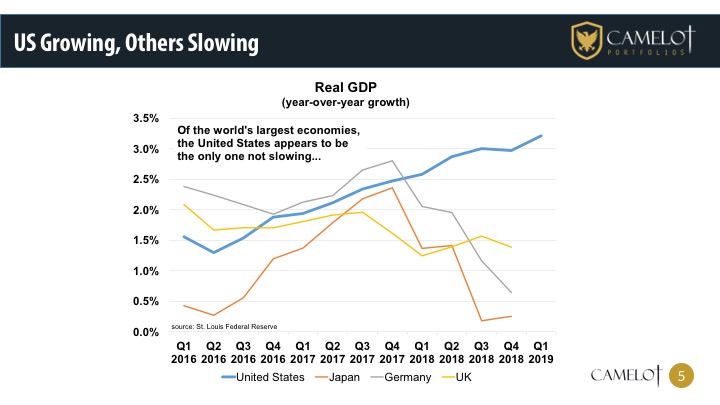
As we’ve shown in recent months, GDP for the major foreign economies (China, Japan, Germany and UK) has been slowing, while US GDP has been accelerating. But economic data at the margin suggests that the strength in the US could fade.

According to the Institute for Supply Management, the US Manufacturing PMI Index peaked at 60.9 last August, and June’s reading was 51.7 – down from 52.1 in May and 52.8 in April. [ix] Note, readings below 50 signal contraction in the manufacturing sector. We have warned that should this reading fall to 50 or less, the US economy will be at a heightened risk of entering recession.

As for the services sector, the ISM non-manufacturing index fell to 55.1 for June, down from more than 60 during the second half of 2018.[x] This is the weakest level in almost two years.

It’s economic deterioration such as this that likely underpins the Fed’s motivation to reduce interest rates, despite the fact that the S&P 500 is trading near all-time highs. 

Perhaps the most important questions today are: 1) will a 25 basis point reduction in the federal funds rate on July 31st be enough to arrest or reverse the negative economic momentum around the world?; and 2) will positive developments in the major macro variables reinvigorate animal spirits and promote new economic production?

I’d suggest neither are enough just yet. While equities were up big in June, credit market behavior has been uninspiring, which could be signaling something ominous underway in the global economy.  

Much of the US Treasury curve remained inverted during the last month. For example, between May 31 and June 30, the spread between the 3-month and 2-year Treasuries only steepened from approximately -42 to -34 basis points -- according to the St. Louis Federal Reserve. These are levels that we saw during the fall of 2000 and 2006, periods that preceded an eruption of systemic risk.

Screen Shot 2019-07-11 at 3.29.22 PM.png

Meanwhile, month-over-month, the St. Louis Federal Reserve shows that the spread between Baa and Aaa-rated corporate bonds widened from 100 to 106 basis points. This suggests that systemic risk concerns in June grew slightly.

As we see it, the good news is that June brought positive macro event catalysts, and holding all variables constant, one or two quarter-point rate cuts by the Fed could get the Treasury curve out of inversion. But the current inversion in the Treasury curve should be respected, and it will be important to see global economic growth stabilize after almost a year of deceleration. Until we see a more clarified economic outlook, risk management should be a growing priority in coming months. Arguably, this is the kind of environment where one should seek to secure and protect investment gains.

PKH Headshot - Sep 2015.jpg

Paul Hoffmeister is chief economist and portfolio manager at Camelot Portfolios, managing partner of Camelot Event-Driven Advisors, and co-portfolio manager of  Camelot Event-Driven Fund  (tickers: EVDIX, EVDAX).

*******

Disclosures:

•       Past performance may not be indicative of future results. Therefore, no current or prospective client should assume that the future performance of any specific investment, investment strategy (including the investments and/or investment strategies recommended by the adviser), will be profitable or equal to past performance levels.

•       This material is intended to be educational in nature, and not as a recommendation of any particular strategy, approach, product or concept for any particular advisor or client.  These materials are not intended as any form of substitute for individualized investment advice.  The discussion is general in nature, and therefore not intended to recommend or endorse any asset class, security, or technical aspect of any security for the purpose of allowing a reader to use the approach on their own.  Before participating in any investment program or making any investment, clients as well as all other readers are encouraged to consult with their own professional advisers, including investment advisers and tax advisors.  Camelot Portfolios LLC can assist in determining a suitable investment approach for a given individual, which may or may not closely resemble the strategies outlined herein.

•       Any charts, graphs, or visual aids presented herein are intended to demonstrate concepts more fully discussed in the text of this brochure, and which cannot be fully explained without the assistance of a professional from Camelot Portfolios LLC.  Readers should not in any way interpret these visual aids as a device with which to ascertain investment decisions or an investment approach.  Only your professional adviser should interpret this information.

•       Some information in this presentation is gleaned from third party sources, and while believed to be reliable, is not independently verified.


[i] “Stocks Jump as Fed’s Powell Suggests Rates Could Come Down”, by Jeanna Smialek and Matt Phillips, June 4, 2019, New York Times.

[ii] Ibid.

[iii] “Powell Says We’re a Long Way from Neutral on Interest Rates, Indicating More Hikes Are Coming”, by Jeff Cox, October 3, 2018, CNBC.

[iv] “Powell Says Fed ‘Will be Patient’ with Monetary Policy as It Watches How Economy Performs”, by Jeff Cox, January 4, 2019, CNBC.

[v] “Trump and Xi Agree to Restart Trade Talks, Avoiding Escalation in Tariff War”, by Peter Baker and Keith Bradsher, June 29, 2019, New York Times.

[vi] “Trump Announces Migration Deal with Mexico, Averting Threatened Tariffs”, by David Nakamura, John Wagner and Nick Miroff, June 7, 2019, Washington Post.

[vii] “Boris Johnson Promises Tax Cut for 3m Higher Earners”, by Rowena Mason, The Guardian, June 10, 2019.

[viii] Squawk Box, June 27, 2019, CNBC.

[ix] “US Factory Gauge Drops Less Than Forecast But Orders Stall”, by Katia Dmitrieva, July 1, 2019, Bloomberg.

[x] “US Services Gauge Drops to Lowest Since 2017”, by Jeff Kearns, July 3, 2019, Bloomberg.

Potential Fallout: US-China Trade, Brexit, and Who Wins in 2020

by Paul Hoffmeister, Chief Economist - Camelot Portfolios

For this month’s commentary, we are sharing a series of slides and charts -- along with brief comments -- to expand on many of our views about the current market environment.


Slide02.jpeg

As we see it, the 2017 stock market rally was catalyzed by the pro-growth momentum of tax cuts and deregulation. Unfortunately, it was interrupted in 2018 by worries that the Fed would seek to squash it with aggressive rate increases, for fear that too many people working would spark inflation. By December 2018, after the FOMC telegraphed the possibility of two quarter-point rate increases for 2019, stocks seemed to scream for the Fed to stop. Powell & Company arguably conceded to the market, with “patience” having been the standing policy approach since January. Did the rate increases of 2018 go too far? I believe so, especially as other major economies appear to be slowing, and investors and economic actors face the specter of increased US-China trade tensions and Brexit uncertainty.

Slide03.jpeg

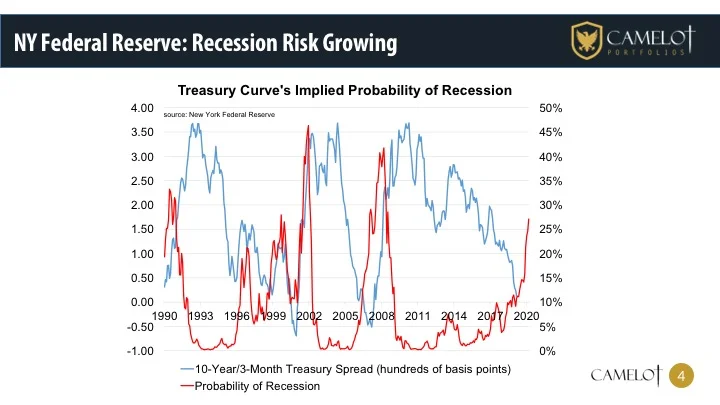
 This chart shows the spread between the 10-year Treasury and 3-month T-Bill through Q1 2019. More recently, that spread inverted and traded near -25 basis points. Certainly, an inverted yield curve can be worrisome, and it’s possible that the US will flirt with a recession within the next 1-2 years. But such a scenario is not inevitable. The US and China could reach a trade agreement, Brexit uncertainties could be clarified, and risk-taking and production in slowing economies could rebound. We need some of the major macro variables to go right in the coming year… According to the CME Fed Watch tool, as of May 30, 2019, fed funds futures were calculating an 85% probability of a rate cut by this December’s FOMC meeting, a 15% probability of no rate cut and no chance of a rate increase. Recently, most Fed officials weren’t predicting a rate cut this year. Who’s going to be proven correct: Fed officials or financial markets?

Register for Paul's Market Update Call
Slide04.jpeg

 Economic risks are rising. According to the New York Federal Reserve: Treasury curve flattening/inversion = increasing probability of US recession.

Slide05.jpeg

Analyzing the five major economies (US, China, Japan, Germany & the UK), the United States has had, in our view, the most pro-growth policy mix of the last 2.5 years: lower taxes + less regulation + fairly stable currency.

Slide06.jpeg

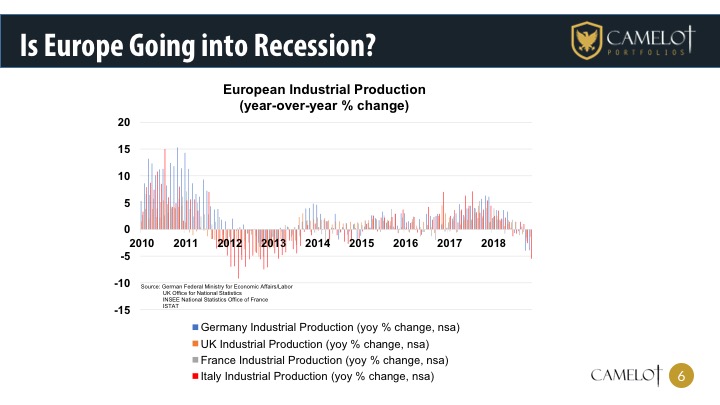
Europe’s economic outlook is deteriorating, at least from the perspective of industrial production. Where is the pro-growth policy response? It seems that the ECB monetary lever will only be used if the situation is dire enough. And major tax cut plans, in many cases, are being obstructed. For example, Italy’s deputy prime minister Matteo Salvini wants his coalition government to implement a 15% flat tax as part of an effort to reduce unemployment to 5% from 10%.[i] But he’s getting pushback from European Commission leaders, who want Italy to observe strict deficit targets.[ii] Very likely, we will soon see a major debate in Europe about whether lower unemployment and growth should be the economic policy objective rather than strict deficit targets.

Slide07.jpeg

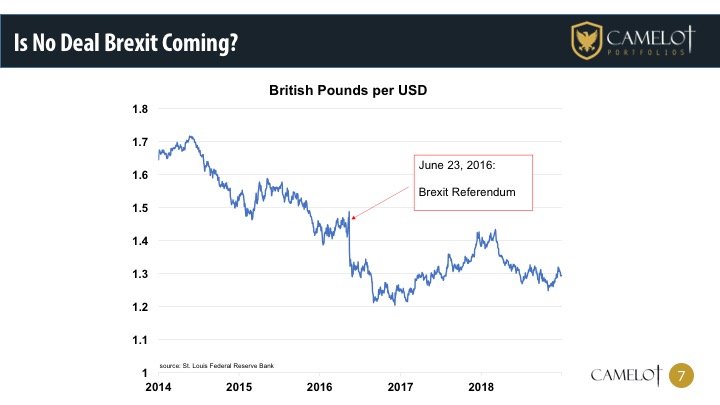
Prime Minister Theresa May wasn’t able to deliver on Brexit, and it seems the UK electorate has punished her Conservative and the Labour parties for it. The May 23rd EU Parliamentary Elections resulted in the Brexit Party winning with 31.6% of the vote – an incredible feat for a party only a few months old.[iii] Labour and Conservatives received 14.1% and 9.1%, respectively.[iv] With this kind of political momentum, the Brexit issue will almost certainly not go away… Note, the anti-Establishment, populist-nationalist sentiment in Europe is growing. Based on the recent parliamentary elections, populist, nationalist parties could control at least 150 seats in the new 751-seat European Parliament.[v] As Salvini put it last week, “the European people are asking for a different Europe.”[vi] The UK is scheduled to leave the European Union on October 31. Should that deadline not be met, Nigel Farage (founder of the UK’s Brexit Party) promises bigger gains in the next general election to sweep the UK’s dominant parties from office.[vii]

Slide08.jpeg

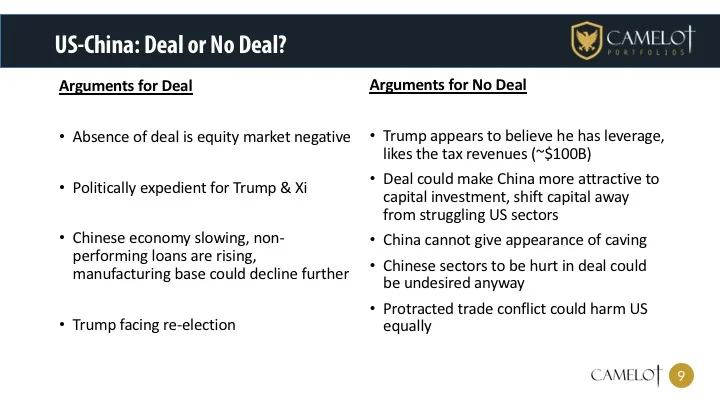
In recent years, the Shanghai Composite appears to be highly sensitive to the US-China trade outlook. This could validate President Trump’s view that the United States has the leverage in these negotiations.

Slide09.jpeg

 Are poor stock market returns in China enough to persuade Chinese leaders to make massive changes to their country’s “business model”? If their economic model has worked so well for the last two decades in catapulting the Chinese economy to becoming the world’s #2, would it be better for China to simply accept the Trump tariffs as a cost of doing business?  

Slide10.jpeg

According to a Bain and Co. survey, 60% of high-level executives at American multinational firms say they’re ready to adjust their business strategies due to the US-China trade dispute.[viii] And anecdotally, we are seeing some manufacturing already shift away from China. Will India, Thailand and Vietnam be the beneficiaries?

Slide11.jpeg

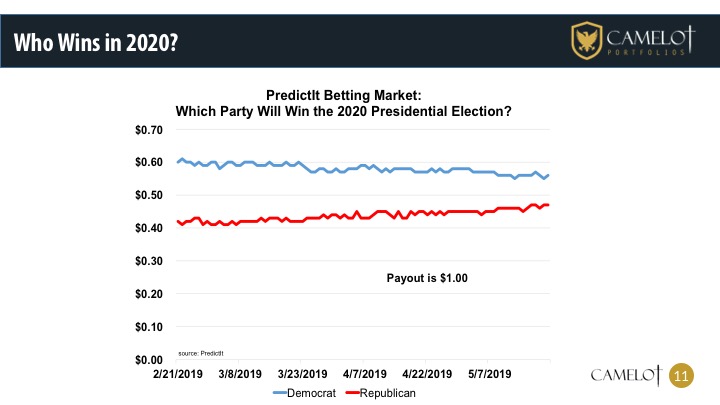
At the moment, the PredictIt betting market believes that Democrats have a better chance of winning the White House in 2020.

Slide12.jpeg

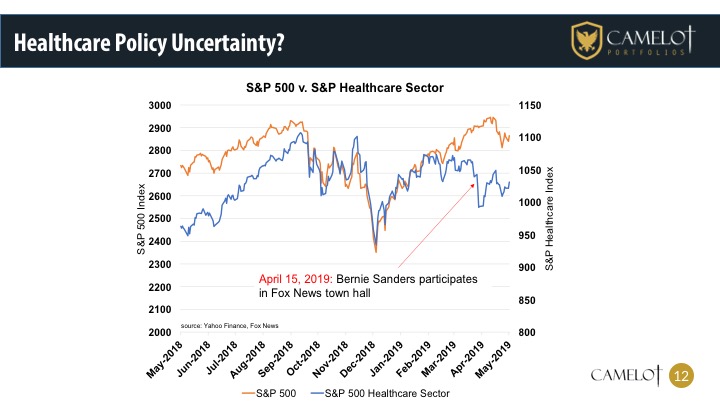
Healthcare may be the biggest election issue that could impact markets as we approach November 2020. For example, Bernie Sanders’ focus on “Medicare for All” during a Fox News town hall arguably pulled the healthcare sector lower in April.


Disclosures:

•Past performance may not be indicative of future results. Therefore, no current or prospective client should assume that the future performance of any specific investment, investment strategy (including the investments and/or investment strategies recommended by the adviser), will be profitable or equal to past performance levels.

•This material is intended to be educational in nature, and not as a recommendation of any particular strategy, approach, product or concept for any particular advisor or client.  These materials are not intended as any form of substitute for individualized investment advice.  The discussion is general in nature, and therefore not intended to recommend or endorse any asset class, security, or technical aspect of any security for the purpose of allowing a reader to use the approach on their own.  Before participating in any investment program or making any investment, clients as well as all other readers are encouraged to consult with their own professional advisers, including investment advisers and tax advisors.  Camelot Portfolios LLC can assist in determining a suitable investment approach for a given individual, which may or may not closely resemble the strategies outlined herein.

•Any charts, graphs, or visual aids presented herein are intended to demonstrate concepts more fully discussed in the text of this brochure, and which cannot be fully explained without the assistance of a professional from Camelot Portfolios LLC.  Readers should not in any way interpret these visual aids as a device with which to ascertain investment decisions or an investment approach.  Only your professional adviser should interpret this information.

•The S&P 500 is an unmanaged index used as a general measure of market performance.  You cannot invest directly in an index. Accordingly, performance results for investment indexes do not reflect the deduction of transaction and/or custodial charges or the deduction of an investment-management fee, the incurrence of which would have the effect of decreasing historical performance results

•Some information in this presentation is gleaned from third party sources, and while believed to be reliable, is not independently verified

A858

paulweb.png

Paul Hoffmeister is chief economist and portfolio manager at Camelot Portfolios, managing partner of Camelot Event-Driven Advisors, and co-portfolio manager of Camelot Event-Driven Fund (tickers: EVDIX, EVDAX).

Join Paul on his Monthly market Call

[i] “Brussels Set to Intervene over Italy’s ‘Fiscal Shock’ Plan”, by Mile Johnson and Mehreen Khan, May 28, 2019, Financial Times.

[ii] Ibid.

[iii] European Election Latest Results 2019: Across the UK”, by Sean Clarke, Pablo Gutierrez and Frank Hulley-Jones, May 26, 2019, by The Guardian.

[iv] Ibid.

[v] “The Latest: Salvini Says Populists Will Control 150 EU Seats”, May 26, 2019, AP News.

[vi] Ibid.

[vii] “Nigel Farage Issues Bold Promise on Action He Will Take If UK Doesn’t Leave on October 31”, by Darren Hunt, May 30, 2019, Express UK.

[viii] “Southeast Asia May Not Be the Next ‘Factory of the World’ Even as Production Moves Away from China”, by Huilen Tan, April 8, 2019, CNBC.

The slow return of Eurosclerosis

by Thomas Kirchner & PAUL HOFFMEISTER

Portfolio ManagerS

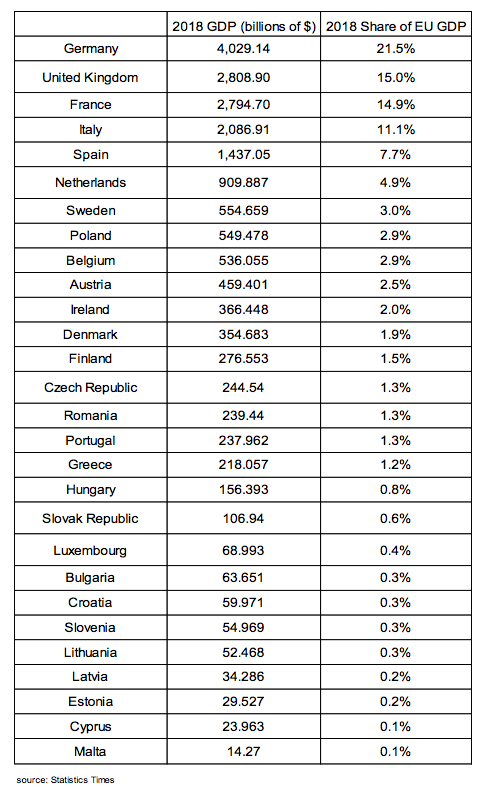
With protests by yellow vests in France approaching their six month anniversary and the European economy showing signs of not a temporary dip, but prolonged weakening, it is a good moment to take a step back and analyze the current situation as well as its implications for the medium to long-term outlook for Europe.As we see it, European economies have been weakening significantly, and even worse, Germany, the European Union’s largest economy comprising almost 21% of the area’s GDP in 2018[i], is on the verge of recession. With Germany the economic locomotive of the euro area, there may not be much reason to be optimistic. The country’s economic problems appear to be structural, due to high taxes, excessive government spending, failed energy policies and other regulatory constraints. Thinking about the years ahead, we aren’t optimistic that the policy response from the German government -- as well as other European governments such as in France, Italy and Greece -- will be strong enough to avoid a prolonged economic malaise for the continent. As a result, we believe that the global economy will suffer from Eurosclerosis in the coming years.

Screen Shot 2019-05-10 at 3.09.34 PM.png

Figure 1: GDP of EU Member States and Share of Total. Source: Statistics Times.

Struggling European Economies

According to the OICA, automobile production in Germany fell 9.3% in 2018[ii], year-over-year. In our view, the prospects for Europe’s leading economy are ominous given that the auto industry is linked to almost 8%% of German GDP.[iii] Business sentiment in Germany appears to have recently turned from euphoria to gloom: as of April 2019, IFO business sentiment has declined 2.8%[iv] while the Markit/BME purchasing managers index has crashed from 58.1 to 44.5 year-over-year[v]

Screen Shot 2019-05-10 at 3.17.15 PM.png

Figure 2: German Automotive Car Production. Source: International Organization of Motor Vehicle Manufacturers

Optimists could point to low unemployment in Germany, which hovers near 5%, according to the OECD[vi]. But low unemployment data could be misleading because German companies can be reluctant to lay off workers, not only because restrictive labor laws make layoffs difficult and expensive, but also because hiring talent can be a lengthy drawn-out process should the economy recover quickly. Many firms experienced that problem during the last decade of relative economic strength when qualified labor was hard to come by and growth for some firms remained below potential due to labor shortages. While this helps to sustain economic statistics, it can destroy corporate profitability and eventually end up costing investors.

According to Eurostat, real GDP growth in Germany is waning, growing only 0.6% in Q4 2018, from 2.8% in Q4 2017[vii]. We are worried about the specter that when Europe’s economic locomotive sneezes, the rest of the continent catches a cold.

Unfortunately, the situation in most of Europe is just as gloomy. According to Eurostat, Italy experienced 0% growth in real GDP year-over-year in Q4 2018 (compared to 1.7% in Q4 2017), while France’s real GDP grew 1.0% in Q 2018 (compared to 2.8% in Q4 2017)[viii]. While Italy seems hard pressed to enact aggressive pro-growth stimulus due to European Union budgetary rules, there doesn’t seem to be much appetite by President Macron to catalyze the French economy by increasing business-friendly incentives. Furthermore, the ongoing protests by the yellow vests inside France, which underscore the economic frustration among many French people, should hamper the growth picture further. And across the Channel, the UK may or may not struggle with Brexit, and while the eventual outcome could be positive, strains during any transition are likely.

The sluggish GDP data in Europe is supported by poor industrial production, which has been declining in Italy, the UK, France and Germany since late 2017. In sum, the four leading European economies appear to be simultaneously entering a state of economic distress.

Screen Shot 2019-05-10 at 3.16.54 PM.png

Figure 3: European Industrial Production.

We believe that the current downcycle in Europe is a harbinger of something much bigger: a secular economic decline in Europe driven by lackluster performance by Germany due to a series of poor policy decisions and even outright policy failures. Germany is yet again set to become the sick man of Europe. In our view, like 20 years ago when the German economy was a laggard, the problems appear to be self-inflicted: a combination of encrusted labor markets with well-intentioned but costly and failing reforms.

Energy

Energy policy is one of Germany’s most significant policy failures. Following the Fukushima nuclear disaster of 2011, Chancellor Merkel single-handedly flip-flopped on longstanding conservative support for nuclear energy and announced the phasing out of all of Germany’s nuclear reactors by 2022. To some people today, it is understood that this radical shift was less motivated by fears of a nuclear disaster, and more so by fears of political gains by the Green Party, which scored significant regional electoral victories in the immediate aftermath of Fukushima. Merkel’s strategy worked well for her, allowing her to hold on to power. Unfortunately, it worked less well for the users of electric energy and the German economy at large and is an example of well-intentioned government policy gone bad.

Estimated annual subsidies of nearly 15 to 40 billion Euros, according to Clean Energy Wire[ix], may be required to implement this policy failure. While industrial users of electricity have their consumption subsidized, it may not be enough to fully offset the pincreases wrought by the replacement of nuclear power by more expensive alternatives, renewables in particular. BASF’s ex-CEO Kurt Bock, who has been a vocal critic of high energy prices in Germany, curtailed his company’s investments there, despite electricity subsidies available to industrial users.

At the same time, households are bearing the brunt of the burden because retail electricity prices are used to finance the subsidies to industrial users and now pay some of the highest electricity prices in the world. Less affluent households see their power cut off for non-payment of electricity bills at a record rate[x]. And one nuclear power plant that had been completed only recently operated for only 13 months before being dismantled, costing energy company RWE losses of at least five billion Euros[xi].

Policy planners in the German government were hoping that wind and solar energy would replace the production capacity lost from nuclear reactors. A massive buildout of these technologies has dotted the country’s landscape, particularly in the north, with windmills. At a nominal capacity of over 100GWh, equivalent to five Chinese Three Gorges Dams, wind and solar now exceed peak demand[xii]. But only on paper.

Because they work only when the wind blows or the sun shines, their contribution to energy production is highly variable. The unreliability of renewables has meant that an equal capacity of conventional coal and gas power plants had to be built, effectively doubling the amount of capital needed to produce a given amount of electricity and boosting electricity costs.

The variability of energy production by renewables poses serious challenges to the operators of the electricity grid. Widespread blackouts can be avoided only by shutting off electricity to power users such as aluminum furnaces or glass manufacturers. 78 such mini-blackouts occurred last year[xiii]. Unreliable electricity coupled with high costs is something found otherwise in developing countries, and this may be the direction in which the German economy is heading as the energy policy failure is beginning to lead to a slow, and perhaps certain deindustrialization.

Chemical giant BASF is the most vocal and prominent company so far to have announced its intention to reduce investments in plants in Germany – other companies have taken this decision quietly without much fanfare, such as SGL Carbon, which built its latest carbon fiber factory in the United States instead of Germany.

Excessive government spending, high taxes

Although uninhibited government spending is far from being a uniquely German problem, it has become particularly problematic as a result of the relatively strong performance of the German economy during the last decade or so.

Since Merkel’s accession to power in 2005, tax revenue has increased by 78%[xiv], yet many core government activities suffer from acute underfunding. The army’s desolate condition has been well documented elsewhere – not a single functioning submarine, pilots who cannot complete their required minimum flight hours due to a large number of aircraft permanently grounded for service, and even the fleet of aircraft shuttling government ministers around the world tends to break down during state visits to remote locations. Even Angela Merkel arrived late to the G20 summit in Argentina late last year after her aircraft experienced technical difficulties. Netjets might go out of business with such a track record. Although infrastructure is still generally in excellent condition, maintenance has been delayed due to lack of funds so that future deterioration has become inevitable.

Where did all the money go? Government debt declined by approximately 5% between 2012 and 2017 but still exceeds pre-crisis levels by almost one third[xv]. Spending categories with the largest increases are personnel and material costs. So ever more bureaucrats need ever more offices.

A good example is the Chancellery in Berlin: Angela Merkel’s staff has increased from 400 to 750, so only 18 years after its completion, Berlin’s Chancellery has become too small. An extension with 400 new offices will cost 460 million Euros – more than one million per office[xvi]. At that cost we can only hope that the offices will be stately and representative, although it is more likely that they will look dull and dreary as government offices typically do. In any case, the decade-long timeline until completion leaves plenty of room for cost overruns. Further spending increases are seemingly guaranteed, as public sector unions have negotiated an 8% raise[xvii].

The irony about the increase of tax revenue from less than 20% to over 23% of GDP during Merkel’s term in office is that she campaigned on an increase in value added taxes to be offset by a reduction in income taxes[xviii]. Once in power, value added taxes went up as promised, as did a host of other taxes, particularly taxes on capital; the promised reduction in income taxes was shelved. Tax cuts were last implemented nearly 20 years ago by former Chancellor Schroeder’s left-leaning government.

Ever more bureaucrats also means that they need ever more areas to regulate. Despite steady population growth, the city administration in Berlin has reduced the number of housing permits issued, and it has lengthened the time it takes to receive a permit. Residential housing in Berlin can now take ten years from concept to completion. To appease an angry public, the local government talks about expropriating residential REITs without explaining how that would increase the stock of housing.

Social spending largesse

Not only in phasing out nuclear energy did Merkel adopt positions that were previously held only by her coalition partner SPD, following the 2017 election, she wholeheartedly allowed Social Democratic ministers to implement numerous expensive programs, the costs of which have saddled taxpayers with enormous unfunded liabilities. For example, the extension of pension benefits to stay-at-home mothers who raise children but make no pension contributions will cost billions, with even higher costs for decades after that. This follows a 2013 decision to offer free childcare to all.

To the chagrin of Social Democrats, none of these new programs have translated into electoral benefits for them. The SPD’s standing in the polls today is the lowest ever. Were elections held tomorrow, they would underperform their lowest election result ever.

In a desperate attempt to stem its decline, the current SPD leadership now tries to do more of what has failed before: more spending. Given Merkel’s record of appeasing her coalition partner, there is a good chance that taxpayers will be saddled with even more liabilities.

Political uncertainty

Merkel’s decision not to run again in the 2021 election has turned her into a lame duck chancellor and introduces significant political uncertainty. It is surprising that Merkel chose this route due to the risk of recreating the atmosphere of inaction that permeated the last years of the Helmut Kohl era during the late 1990s, who was her mentor and whose office ended when he lost an election after voters grew tired of him. Arguably, her decision to retire at the time of the election was driven by a desire to avoid such an embarrassing election loss. However, two years of stalemate will mean that her departure will likely have a negative tone.

Another sobering aspect of Merkel’s departure plan has been the appointment of her successor. Normally, a successor would be expected to break with the Merkel era. However, Annegret Kramp-Karrenbauer (“AKK”) is perceived to be Merkel’s mini-me, who will perpetuate Merkel’s overall policies, including the politically unpopular aspects of energy policy and migration. Friedrich Merz, a free marketeer with a deeper understanding of economic policy, deregulation and taxes, lost narrowly. We believe, however, that there is a chance that he will be involved in a future government and potentially even stage a challenge to AKK, although that may not happen until after the 2021 election. AKK’s economic thinking does not appear growth-friendly, namely her support for an increase in the top individual income tax rate from 42% to 53% and her opposition to inflation-indexing of tax rate thresholds, leading to creeping tax increases[xix].

Malaise set to worsen

After a decade of ultra-low interest rates, the German economy that helped to keep Europe going is not only slowing but may be in a much more precarious position than before the financial crisis. Therefore, the real risk today is not just a cyclical recession, but a prolonged downturn. Overcoming a decade of significant policy errors is not going to be achieved during the normal duration of a recession, much less so if you also need to overcome a decade of misinvestment due to low interest rates and onerous tax policies.

The impact of an emergent economic downturn on employment is likely to be muted at first because companies will be reluctant to fire workers. This is partly the effect of stringent employment laws that make it difficult to adjust the size of the workforce to changes in production, and partly companies’ recent experience of extremely difficult hiring conditions.

While the German economy is flooded with low-skilled and unskilled workers, partly as a result of recent migratory trends, qualified workers with strong technical backgrounds are scarce and companies were unable to fill many such jobs during the recent boom. As a result, many companies will keep workers on the payroll and hope to ride out the recession. This favorable employment picture in the midst of a recession will likely reduce political pressure for much-needed reforms and exacerbate problems in the future.

The most likely response by governments to reduced tax and social security receipts will be tax increases, rather than reductions in spending or aggressive tax cuts on investment capital. If you want less of something, tax it. As such, tax increases will only exacerbate the slowdown in economic activity through a decline in investment. Although the nominal tax rate on capital in Germany is 25%, only five points higher than in the U.S., this rises to almost 30% once various surcharges are included[xx]. Moreover, deductibility of losses has been curtailed sharply in the name of tax justice to ensure that companies pay a minimum tax rate, which reduces the attractiveness of investments that are profitable in the long run but are lossmaking early on.

Not surprisingly, investment is limited in many cases to saving projects in established firms. While there has been a mini-boom in internet and technology firms, it is nowhere near a level that you would expect from the fourth largest economy in the world. Germany is lagging far behind technology leaders U.S.A. and China. Nothing illustrates this lag better than the opening of offices in Silicon Valley by the few German technology and internet companies who end up succeeding and want to gain scale. They desire to tap into venture capital and the technology scene in general, which is woefully lacking inside Germany. A study by PwC of the Global 100 Software Leaders lists only five German companies among the top 100 by revenue, and we would question whether Siemens should even be counted as a software company so that the real share is a measly four out of 99[xxi].

The Kiel Institute for the World Economy (IfW) sees Germany in a much weaker economic position than prior to the 2008 financial crisis because of deficiencies in infrastructure spending and a lack of corporate tax reform since the government of Chancellor Schröder nearly two decades ago[xxii].  IfW warns that bureaucracy has increased and with trade partners from Europe to China experiencing an economic slowdown, export growth will not likely bail out the economy this time. We would add that the U.S. is going to be the beneficiary of the corporate tax stalemate thanks to U.S. corporate tax rates that are now in line with Switzerland, the U.K. and Eastern Europe.

Germany’s economy remains rooted in old tech such as chemicals, industrial equipment and automobiles. While these industries have generated substantial trade surpluses over the last decade, this has not led to a corresponding increase in household wealth. Today Germans are, on average, less wealthy than Italians, Spaniards or the French[xxiii]. In our view, an important factor behind this discrepancy is the low rate of homeownership, and also the propensity to invest savings in assets with low volatility, mainly low-yielding savings accounts and life insurance policies, which prevents savers from accumulating wealth. Even worse, negative interest rates have reduced the wealth of citizens while facilitating excessive government consumption.

While it is true that many of the problems faced by the German economy are faced by other economies elsewhere in the world, too, it is the ignorance by the political leadership of the origins of the strong economic performance that is unique. Wealth and growth are taken for granted, capitalism is considered evil and must be contained. The United States also suffers from a terribly inefficient public sector, but a combination of low tax rates, entrepreneurship and readily available capital for new ventures offset many of these problems.

As a consequence, we believe that Europe will return to a state of Eurosclerosis in the decade of 2020, triggered by the inability of Germany to continue to act as the growth engine for the continent. Continued problems in the European periphery from Italy to Greece are likely to add to the downward economic pressure.

Investment Implications of Eurosclerosis

For investors, Euroscelrosis raises the question of portfolio implications. The old dogma of not investing in European companies and instead investing in U.S. firms no longer works due to globalization. For example, Roche had only 24% of its 2018 sales in Europe, while Bristol-Myers Squibb achieved a similar percentage of its sales there[xxiv]. Substituting European pharma Roche with an investment in U.S.-based Bristol-Myers will in no way reduce portfolio exposure to the European economy. This is a practical consequence of globalization: everyone has global exposure. Therefore, traditional large and mega cap investment strategies offer poor prospects for reducing portfolio exposure to Europe by divesting Europe-based stocks.

In our opinion, the impact of Eurosclerosis is more benign, potentially even favorable for event-driven investments. In a weak economy the pressure to optimize corporate structures is likely to increase, in particular when European companies benchmark themselves against U.S. firms that have gone through a decade of mergers and splits. Therefore, opportunities in merger arbitrage and spin-offs should increase, while simultaneously a growing number of distressed opportunities will arise.  While Eurosclerosis will be difficult for traditional investment strategies we believe that it will present many opportunities for event-driven investors.


thomas_kirchner_high_res.jpg
PKH Headshot - Sep 2015.jpg

Mr. Kirchner has been responsible for the day-to-day management of the Camelot Event Driven Fund since its 2003 inception. Prior to joining Camelot he was previously was the founder of Pennsylvania Avenue Advisers LLC and the portfolio manager of the Pennsylvania Avenue Event-Driven Fund. He is the author of 'Merger Arbitrage; How To Profit From Global Event Driven Arbitrage.' (Wiley Finance, 2nd ed 2016)


Paul Hoffmeister is chief economist and portfolio manager at Camelot Portfolios, managing partner of Camelot Event-Driven Advisors, and co-portfolio manager of Camelot Event-Driven Fund (tickers: EVDIX, EVDAX).


[i] Statistic Times based on IMF data.

[ii] International Organization of Motor Vehicle Manufacturers (“Organisation Internationale des Constructeurs d’Automobiles”).

[iii] “German Car Trouble and the CEE”, April 4, 2019, ING.

[iv] „ifo Business Climate Index Falls.“ ifo Institute for Economic Studies, Munich, April 24, 2019.

[v] https://tradingeconomics.com/germany/manufacturing-pmi

[vi] OECD (2019), Unemployment rate (indicator). doi: 10.1787/997c8750-en (Accessed on 07 May 2019).

[vii] GDP growth rates in the fourth quarter of 2018, % change over the previous quarter, based on seasonally adjusted data - Source: Eurostat (namq_10_gdp).

[viii] Ibid.

[ix] Sören Amelang; “How much does Germany’s energy transition cost?” Clean Energy Wire, 01 Jun 2018.

[x] „Mehr Haushalten wegen unbezahlter Rechnungen Strom abgestellt“ faz.net, November 10, 2018.

[xi] Michael Rasch: „Wahrzeichen des deutschen Verwaltungswahnsinns“ nzz.ch, February 7, 2019

[xii] Sandra Enkhardt: „Renewables surpassed fossil fuels capacity in Germany last year.” Pv-maganzine, November 28, 2018.

[xiii] Holger Douglas: „Deutschland (fast) ohne Strom“ tichyseinblick.de, January 21, 2019.

[xiv] Author’s calculations based on data from https://www.bundesfinanzministerium.de/Content/DE/Standardartikel/Themen/Steuern/Steuerschaetzungen_und_Steuereinnahmen/2-kassenmaessige-steuereinnahmen-nach-steuerarten-1950-bis-2017.html

[xv] Eurostat.

[xvi] „Bundeskanzleramt: Neubau mit 400 Büros für 460 Millionen Euro“ Handelsblatt, January 15, 2019.

[xvii]Detlef Essinger: “ Acht Prozent mehr Gehalt im öffentlichen Dienst” sueddeutsche.de, March 2, 2019.

[xviii] Ansgar Neuhof: „Große Koalition: Nichts kommt den Bürger teurer“ Tichys Einblick, December 13, 2017.

[xix] Jürgen Streihammer: „‘Wir Sozialdemokraten‘: Als die CDU-Chefin ihre Partei verwechselte.“ Die Presse, February 11, 2019.

[xx] „International Tax - Germany Highlights 2019.“ Deloitte Touche Tohmatsu Limited, January 2019.

[xxi] „PwC Global 100 Software Leaders“ PwC, Available at pwc.com/gx/en/industries/technology/publications/global-100-software-leaders/explore-the-data.html

[xxii] Kiel Institute Economic Outlook Germany, Nr. 53 (2019 | Q1).

[xxiii] Vereinigung der Bayerischen Wirtschaft e. V.: „Die Vermögensverteilung im internationalen Vergleich.“ Institut der deutschen Wirtschaft e. V., June 2018.

[xxiv] Annual reports for Roche Holding AG and Bristol-Myers Squibb Company per December 31, 2018.

Disclosures:

•       Past performance may not be indicative of future results. Therefore, no current or prospective client should assume that the future performance of any specific investment, investment strategy (including the investments and/or investment strategies recommended by the adviser), will be profitable or equal to past performance levels.

•       This material is intended to be educational in nature, and not as a recommendation of any particular strategy, approach, product or concept for any particular advisor or client.  These materials are not intended as any form of substitute for individualized investment advice.  The discussion is general in nature, and therefore not intended to recommend or endorse any asset class, security, or technical aspect of any security for the purpose of allowing a reader to use the approach on their own.  Before participating in any investment program or making any investment, clients as well as all other readers are encouraged to consult with their own professional advisers, including investment advisers and tax advisors.  Camelot Event Driven Advisors can assist in determining a suitable investment approach for a given individual, which may or may not closely resemble the strategies outlined herein.

•       Any charts, graphs, or visual aids presented herein are intended to demonstrate concepts more fully discussed in the text of this brochure, and which cannot be fully explained without the assistance of a professional from Camelot Event Driven Advisors.  Readers should not in any way interpret these visual aids as a device with which to ascertain investment decisions or an investment approach.  Only your professional adviser should interpret this information.

A850