An Arbitrageur’s View of Negative Oil Prices

Until this week, negative energy prices were known to only occur in Germany’s renewables-fueled electricity market. Anytime a breeze blows during the summer while the sun is shining, so much excess electricity is generated that German consumers are paid for burning electricity. The underlying cause is the lack of technology for electricity storage on a large scale.

Storage is easier to find for oil: when too much of it is produced, then the excess ends up in giant storage tanks. Sometimes, even oil tankers are chartered for storage. But, what’s unusual now is the fact that as a result of lower oil consumption due to the corona crisis, oil tanks are filling up almost everywhere. JP Morgan estimated at the beginning of April that all available storage capacities on land would be fully utilized by the end of May. In June, the last tanker on the high seas might be full to the brim.

Regional bottlenecks may occur even earlier, such as these days in the town of Cushing, Oklahoma. With a population of 7,800, it does not have the vibe of a global oil trading hub. But on the first day of every month, Cushing is the physical delivery location for crude oil futures traded on the New York commodities exchange known as NYMEX. Delivery options are somewhat limited: only tanks and pipelines managed by Enterprise or Enbridge qualify.

Most futures contracts are closed out before the delivery date and no physical oil ever changes hands. The futures price typically serves market participants as a reference price for other oil transactions that they index to it. And for anyone who actually accepts physical oil delivery in Cushing, they have to store it somewhere, and that storage capacity is currently in short supply. In fact, the limited facilities in Cushing or those that are easily accessible from Cushing are full. As a result, many oil traders were forced to sell their futures contracts for May 1st delivery before the last trading day on April 21st. Due to the storage problems, few buyers were able to step in. With an excess of sellers over buyers, the price not only went to zero, but collapsed into negative territory to a low of -$40.32.

Remarkably, the prices of futures for June 1st delivery or for the following months were not as significantly affected by this extraordinary set of circumstances. Crude oil for delivery on June 1 held above $20, and the subsequent delivery months were correspondingly higher in price.

Under normal market conditions, arbitrageurs ensure the integrity of futures prices. Hence, prices differ from one month to another mainly by storage costs of under one to two dollars per barrel per month. If prices diverge by more than that, arbitrageurs could buy oil futures with a delivery date of May 1st, sell at the same time futures for delivery on June 1st and store it temporarily for a month. If prices differ by more than the storage costs the arbitrageurs can make risk-free profits. For example, with negative futures prices of -$40 for the May 1st delivery and positive prices of $20 for June 1st delivery, an astronomical profit of $59 could be generated without much risk. But only in theory, because this strategy won't work without storage capacities. And if the arbitrage strategy cannot be implemented, then prices can diverge to non-economic levels.

Instead of arbitrageurs making profits in oil, bargain hunters ended up facing huge losses. Anyone who bought an oil future for $17 a barrel on Monday morning had to pay $38 in the evening to get rid of it. A loss of 324 percent in less than a day.

Some other circumstantial evidence suggests that the negative price was not real but merely a technical phenomenon. Brent oil futures did not face a similar move in the price of the front month. The important difference between Brent and WTI futures are that Brent futures are cash settled rather than settled through physical delivery of oil. Moreover, the oil underlying Brent is traded in Rotterdam, a maritime port that in addition to having pipeline access is also reached by oil tankers. In contrast, the oil in Cushing is landlocked so that transportation is limited by pipeline capacity.

In theory, oil futures contracts that allow for physical delivery should produce price discovery that is closer to the actual underlying; however, as we see all too often, theory and practice don’t always align. It is up to the NYMEX to modify the contract specifications in a way to minimize delivery problems in the future.

Physical delivery always gives rise to opportunities for mispricing, whether by accident as in the case of this week’s WTI oil price behavior, or by deliberate market manipulation. One of the authors used to trade bonds in Europe and often observed games being played with bonds deliverable into European government bond futures contracts. This is much less of a problem for the U.S. Treasury futures contract due to the much larger size of U.S. government debt compared to that of individual European countries. The parallels between delivery problems in bond futures and oil suggest that it is time for a complete overhaul of physically settled commodities futures – what happened in oil this week could perhaps happen pork bellies or other commodities in the future.

We will see during the next few days who shouldered the losses on the NYMEX WTI futures that went negative in price. The big ETFs and most professional oil investors usually roll their exposures weeks before the expiration of the futures contracts. They are well aware of the risks of waiting to the last minute. Therefore, the parties remaining on Monday were probably opportunistic investors that dabble in oil only occasionally and saw $20 as a great entry point for the long run, without realizing the roll problems that can be experienced in the physical settlement of futures contracts. Given the amount of leverage that can be employed with futures, some speculators are likely to have suffered devastating losses.

thomas_kirchner_web_res.jpg

Thomas Kirchner, CFA has been responsible for the day-to-day management of the Camelot Event Driven Fund since its 2003 inception. Prior to joining Camelot he was previously was the founder of Pennsylvania Avenue Advisers LLC and the portfolio manager of the Pennsylvania Avenue Event-Driven Fund. He is the author of 'Merger Arbitrage; How To Profit From Global Event Driven Arbitrage.' (Wiley Finance, 2nd ed 2016).

PKH Headshot - Sep 2015.jpg

Paul Hoffmeister is chief economist and portfolio manager at Camelot Portfolios, managing partner of Camelot Event-Driven Advisors, and co-portfolio manager of Camelot Event-Driven Fund (tickers: EVDIX, EVDAX).


B040 

 Disclosures:

•       Past performance may not be indicative of future results. Therefore, no current or prospective client should assume that the future performance of any specific investment, investment strategy (including the investments and/or investment strategies recommended by the adviser), will be profitable or equal to past performance levels.

•       This material is intended to be educational in nature, and not as a recommendation of any particular strategy, approach, product or concept for any particular advisor or client.  These materials are not intended as any form of substitute for individualized investment advice.  The discussion is general in nature, and therefore not intended to recommend or endorse any asset class, security, or technical aspect of any security for the purpose of allowing a reader to use the approach on their own.  Before participating in any investment program or making any investment, clients as well as all other readers are encouraged to consult with their own professional advisers, including investment advisers and tax advisors.  Camelot Event Driven Advisors can assist in determining a suitable investment approach for a given individual, which may or may not closely resemble the strategies outlined herein.

•       Any charts, graphs, or visual aids presented herein are intended to demonstrate concepts more fully discussed in the text of this brochure, and which cannot be fully explained without the assistance of a professional from Camelot Event Driven Advisors.  Readers should not in any way interpret these visual aids as a device with which to ascertain investment decisions or an investment approach.  Only your professional adviser should interpret this information.

Originally published on http://www.camelotportfolios.com/commentaries

A Race Against Time?

By Paul Hoffmeister

The 20% decline in the S&P 500 Index in the first quarter was the index’s worst first quarter performance in history, and its ninth worst calendar quarter performance ever. Most of the other major quarterly declines coincided with the Great Depression, the Black Monday crash of 1987, and the 2008-2009 Financial Crisis. Financially, the panic today is on par with some of the worst the country has ever seen. And on a personal level, too many Americans have died from this new virus, and the country is enduring a quarantine not experienced since 1918. We are, indeed, enduring a tragic moment in our country’s history.

While the S&P 500 was down -8.4% in February and then -12.5% in March, the sharp selloff in stock prices really began in late February when it became increasingly clear that the small clusters of Covid-19 infections outside of China had spread to the rest of the world. Quickly, the surreal images of ghost towns and overwhelmed hospitals in the city of Wuhan became a reality for almost everyone.

Screen Shot 2020-04-13 at 1.14.16 PM.png

A forensic examination of the recent market selloff shows that the eruptions of Covid-19 infections in Italy, South Korea and Iran during the last week of February were arguably the catalyst for the recent panic selling in stocks, as the epidemic in Asia turned into a global pandemic. By late March, the White House’s leading medical advisors, Dr. Anthony Fauci and Dr. Deborah Birx, were warning publicly that between 100k and 2.2m Americans would die as a result of this new virus.[i] To put today’s tragedy into context, the total number of Americans killed in all U.S. wars has been approximately 1.1 million, according to PBS.[ii]

Screen Shot 2020-04-13 at 1.14.23 PM.png
 
Register for market update call
 

Of course, to slow the spread of the virus or “flatten the infection curve”, governments aroundthe world have issued travel restrictions and stay-at-home guidelines, which has come with great economic cost. As the Wall Street Journal’s Holman Jenkins put it, nearly 83% of the U.S. economy has been suppressed to relieve the pressure on the healthcare system.[iii]

How much has this virus and the global shutdown cost? Between December 31, 2019 and March 31, 2020, the market capitalization of the world’s equity markets fell $18.5 trillion to $68.5 trillion, according to the Bloomberg World Exchange Market Cap Index.

This massive and relatively sudden haircut in market wealth makes sense given the magnitude and velocity of the current economic slowdown and surge in unemployment. We are now bracing ourselves for a 20-30% contraction in US GDP, and just last week, an unprecedented 6.5 million Americans filed for unemployment. We expect these staggering job losses to continue while most of the US economy remains closed. Former Federal Reserve Chairman Janet Yellen believes that the true unemployment rate is already 12-13%.[iv]

The critical questions for investors are, what’s being done now to manage the pandemic and economic hardship, and will equity markets return to their previous highs anytime soon?

Aside from an aggressive effort to ensure the availability of healthcare equipment and therapies for the most stricken hot spots in the country, the federal policy response has been focused on providing temporary economic relief to individuals and corporations to weather the pandemic. The policy response has been politically down-the-middle, with a lot of temporary spending and credit measures.

The progressive left will be disappointed that no major, relatively permanent social safety net structures have been instituted (such as new broader, long-lasting federal healthcare programs), while the pro-growth right will be disappointed that no permanent improvements in economic incentives have been created (such as sharp tax rate reductions). This policy response is perhaps the only realistic outcome of a Republican-controlled White House and Democratically-controlled House.  

Notwithstanding, recent spending and credit programs have been massive. By the end of March, the White House and Congress approved the CARES Act, which will provide more than $2 trillion in economic relief -- the largest economic package ever passed by Congress. Included in the legislation are $1200 payments to most Americans, nearly $350 billion in partially forgivable loans to small businesses and non-profits, and $500 billion for the Treasury and Federal Reserve to provide liquidity and purchase corporate, municipal and state debt.[v] Reportedly, the Trump Administration is negotiating another $2 trillion dollar bill focused mainly on infrastructure spending.

In addition to these fiscal measures, the Federal Reserve among many other things slashed the federal funds rate from its 1.50%-1.75% target range to 0%-0.25% (we’re back to a zero interest rate policy or “ZIRP”), reduced the discount rate to 0.25% and attempted to destigmatize direct borrowing from the Fed, eased regulatory constraints to support lending to households and businesses, and established special facilities to steer credit directly to non-financial corporations.

In our view, the monetary policy response to the current economic crisis has been much faster and more aggressive than in 2008, and the Fed appears to be acting much more in the traditional fashion of a lender of last resort.

To be clear, the federal government’s fiscal and monetary measures today are arguably relief measures, as opposed to stimulus measures. They are policies to assist the broad economy in enduring the trillions of dollars in costs associated with Covid-19 shutdown. This will certainly help many individuals, and financial and non-financial institutions temporarily weather the crisis. But soon, if not already, the economy will need revenues restored.

This means that the economy and financial markets will either improve or devolve during the next few weeks and months based on the spread of Covid-19, the availability of therapeutic and preventative remedies, and the reopening of the economy. Quite simply, financial markets need the spread of the virus to slow, viral treatments to show clear and conclusive efficacy, and the economy to reopen.

Although there is a long way to go, there appears to be light at the end of the tunnel.

As of Tuesday April 7, China reported no new deaths, case numbers in European hotspots Italy and Spain were declining, and fatalities in New York appeared to be plateauing.[vi] As a result, we have seen lockdown restrictions lifted in Wuhan; Austria and Denmark plan to gradually lift restrictions next week; and while the U.S. still appears to be in the acceleration phase of infections, the White House is already crafting a plan to reopen the U.S. economy in the coming months.

As Larry Kudlow, director of the National Economic Council, said yesterday, “We are coming down, I think, the home stretch, that’s what the health experts are telling us.”[vii] Kudlow suggested that the economy will be begin to reopen within four to eight weeks.

A crucial step to reopening will be scaling up testing capabilities in order to better identify infected people and isolate them. Most likely, small towns that are far away from hotspots will be the first to reopen and implement extensive testing and viral surveillance programs. Undoubtedly, progress in therapeutic medicines and the widespread distribution of testing kits are critical today, for public health and the market outlook. Most parts of the economy will not be able to fully reopen without the necessary medical supplies and testing kits.

Screen Shot 2020-04-13 at 1.14.44 PM.png

Defeating Covid-19 and reopening the economy couldn’t happen soon enough for markets. And perhaps the clearest case for that in financial markets is the credit market stress that currently exists. Credit spreads are “blowing out” faster than anything we’ve seen in recent history, and could be headed to 2008-2009 severity levels. There is a wave of corporate defaults on the horizon. The question is, will it be a size typical of periodic storms or a gigantic tsunami?

Given the nature of the federal policy response, which is mostly temporary and palliative, the economy may be in a race against time before either the previously believed once-in-a-multi-generation financial crisis of 2008-2009 happens again, or the federal government needs to step once more with additional capital to bear the burden of the massive economic cost of this pandemic.

How the next four to eight weeks play out is purely speculative. No one can forecast this kind of uncertainty. I am hopeful that human ingenuity will beat Covid-19. Sadly, it has cost the world dearly, in lives and treasure – so far nearly 90,000 deaths[viii] and tens of trillions of dollars. If the virus is not contained quickly and the economy does not reopen at least gradually, the federal government will need to step in again, quickly and aggressively. Unfortunately, we may only have a few weeks. Without question, we need the positive developments of the last week to continue. Evidence that the progress has temporarily stalled could mean the difference between a huge recovery rally and another bout of financial market panic.


Paul Hoffmeister, Chief Economist, Camelot Portfolios, LLC

Paul Hoffmeister is chief economist and portfolio manager at Camelot Portfolios, managing partner of Camelot Event-Driven Advisors, and co-portfolio manager of Camelot Event-Driven Fund  (tickers: EVDIX, EVDAX).

Register for market update call

*******

Disclosures:

•       Past performance may not be indicative of future results. Therefore, no current or prospective client should assume that the future performance of any specific investment, investment strategy (including the investments and/or investment strategies recommended by the adviser), will be profitable or equal to past performance levels.

•       This material is intended to be educational in nature, and not as a recommendation of any particular strategy, approach, product or concept for any particular advisor or client.  These materials are not intended as any form of substitute for individualized investment advice.  The discussion is general in nature, and therefore not intended to recommend or endorse any asset class, security, or technical aspect of any security for the purpose of allowing a reader to use the approach on their own.  Before participating in any investment program or making any investment, clients as well as all other readers are encouraged to consult with their own professional advisers, including investment advisers and tax advisors.  Camelot Portfolios LLC can assist in determining a suitable investment approach for a given individual, which may or may not closely resemble the strategies outlined herein.

•       Any charts, graphs, or visual aids presented herein are intended to demonstrate concepts more fully discussed in the text of this brochure, and which cannot be fully explained without the assistance of a professional from Camelot Portfolios LLC.  Readers should not in any way interpret these visual aids as a device with which to ascertain investment decisions or an investment approach.  Only your professional adviser should interpret this information.

Some information in this presentation is gleaned from third party sources, and while believed to be reliable, is not independently verified.


[i] “Dr. Birx predicts up to 200,000 U.S. coronavirus deaths ‘if we do things almost perfectly,’ by Ben Kesslen, March 30, 2020, NBC News.

[ii] “How many Americans have dies in U.S. wars?” by Megan Crigger and Laura Stanthanam, May 27, 2019, PBS.

[iii] “Questioning the Clampdown,” by Holman Jenkins, March 17, 2020, Wall Street Journal.

[iv] “Janet Yellen says second quarter GDP could decline by 30% and unemployment is already at 12-13%,” by Jeff Cox, April 6, 2020, CNBC.

[v] Source: www.whitehouse.gov

[vi] “Asian shares rise, echoing Wall Street optimism on virus battle,” by Yuri Kageyama, April 7, 2020, SFGate.

[vii] “Trump Team Preps Plans to Reopen Economy That Depend on Testing,” by Mario Parker, April 7, 2020, Bloomberg.

[viii] Source: Center for Systems Science and Engineering (CSSE) at Johns Hopkins University.


B011


Special Market Update

Camelot Portfolios

 Dear Friends,

The 20% decline we mentioned in our update last week swiftly became a 30% decline as the panic and economic damage over the Coronavirus continued to intensify.  We have now seen 3 days in a row with roughly 10% moves in the equity markets, leaving us at fresh closing lows today (Monday 3/16/2020).  The 12% selloff came despite significant Fed action over the weekend – including an emergency rate cut of 100 bps and a new $700 Billion Quantitative Easing program.

 I have heard in many conversations with advisors and clients the belief that this is going to get much worse before it gets better.  While this is absolutely true about the Coronavirus, it may or may not be true about the markets.  The stock market is a forward-looking discounting mechanism and is well-aware that the virus & economic fallout will get much worse.  This is why the market fell roughly 20% in just the last week.  In addition, we are seeing panic selling & forced selling (margin calls), which push the market further down.

The concerns expressed in our last couple updates regarding the credit markets are now elevated as cracks are appearing in several places.  A full-blown credit crisis could easily take the market down another 20%.  The Fed is now throwing trillions of dollars at this situation to keep it from spiraling out of control and whether or not they will be successful remains to be seen.  

Based on suggestions and orders from the President and many Governors over the last several days to self-isolate & shut down businesses, I believe we are now in recession, and it is likely as severe as what we experienced during 2008.  The official recession will not be declared until late this year, but by then we will likely be coming out of it.  The market already knows this and is trying to price it appropriately, but the extent of the damage is impossible to quantify at this point.  This economic damage is what the government needs to address, and quickly.  We expect to see several aid bills in the coming weeks as politicians want to keep their jobs. 

These factors all make it difficult to know where the bottom may be in the markets.  We may have already hit it, but if so, I do not expect a V-bottom like we saw coming out of 2018.  I expect we will chop along for a few weeks with sharp bounces and falls as the market tries to digest the impact of this crisis.  Frankly, I am suspicious of the sharp rallies we are seeing as the VIX and credit markets don’t seem to be supporting the moves.  Either way, if there is further downside ahead of us, I believe it will come fairly quickly and will bottom before the peak of the Coronavirus crisis. 

Bottom line – we are likely near the bottom (within 20%), so investments made at this point will probably produce nice returns 12 months out.  But the economic damage is immense with more to come.  I am concerned it is not yet fully priced into the market, much less over-priced as often happens.  So the best opportunities may still be ahead of us.  I believe the best approach is to start/continue buying on pullbacks in the market.  If we see an opportunity to go all in, we will let you know. 


Kind Regards,

Darren Munn

Chief Investment Officer

Markets, the Coronavirus and Joe Biden

By Paul Hoffmeister

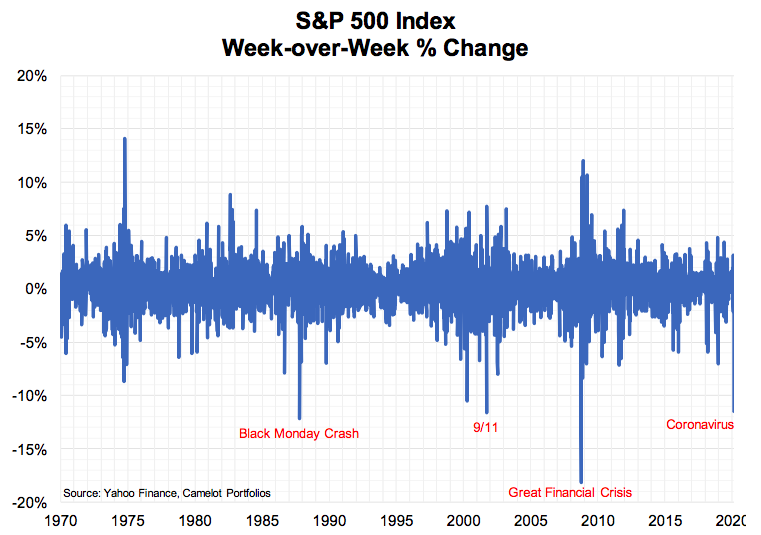
The week of February 24, 2020 will go down in history. The S&P 500’s 11.5% selloff for the week, caused by panic over the Coronavirus, was the fourth worst week-over-week loss for the index since 1970, just behind the week-over-week selloffs during the 2008 Financial Crisis, the October 1987 stock market crash, and the 9/11 terrorist attacks.

Screen Shot 2020-03-10 at 9.21.30 AM.png

What appeared to spark the selloff were reports of viral outbreaks in Italy, South Korea and Iran. In Italy, it was reported that over 200 people had been infected, and at least 10 towns with a population of nearly 50,000 were locked down.[i] In South Korea, the total number of confirmed cases had jumped to more than 800, and the country raised its infectious disease alert to its highest level.[ii] And in Iran, total confirmed cases jumped to almost 50.[iii] The sudden case increases in these countries raised concern that the efforts to contain Covid-19 in Southeast Asia had failed, and that the world was now at the brink of a global pandemic.

Very likely, we’re already there. On Tuesday March 3,, Dr. Anne Schupat, the principal deputy director at the CDC, testified before Congress that the virus had already met two of the three main criteria under the technical designation of a pandemic.[iv] She added, “If sustained person-to-person spread in the community takes hold outside China, this will increase the likelihood that the WHO will deem it a global pandemic.”[v]

It may well be taking hold. Notably, on Wednesday February 26, the CDC reported in California the first incident in the United States of “community transmission” where an infected person was not exposed to anyone known to have been infected with the Coronavirus.[vi] The virus may in fact be more widespread than the official data is currently showing. With testing for the virus now rapidly increasing around the world, it’s likely that we will see a surge in confirmed cases that will meet the conditions for this outbreak to be classified as a global pandemic.

So, as investors, where do we go from here? How do we navigate a variable whose outcomes are highly uncertain and difficult to measure?

Arguably no one can guess how exactly the virus will evolve from here. That would be pure speculation. But perhaps the recent events in China can give us clues about how to think about the next few months, specifically with regard to the spread of the virus and the degree of any US equity selloff.

What may be exceedingly useful is the fact that it appears China is in the late innings of working through the virus, while the rest of the world is in the early innings. According to the World Health Organization, the Coronavirus is now spreading faster outside China. The number of confirmed cases outside mainland China exceeded 10,000 on March 3, compared to 80,300 in China; with 80% of new cases coming from Italy, Iran and South Korea.[vii]

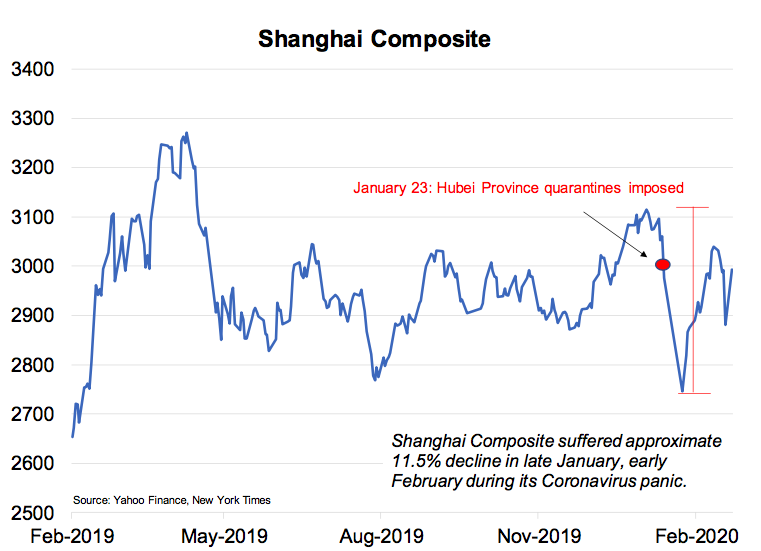
If we use January 23, 2020 (when the Chinese government imposed a lockdown in many parts of Hubei Province) as the start date, then perhaps we can say that it took China 1.5 months, at most, to succeed in controlling the virus. 

Considering that China reportedly imposed extreme measures to contain the virus, including bounties, the utilization of its government surveillance apparatus, and widespread quarantines, it’s possible that the rest of the world will require at least 1.5 months to control the virus and slow its infection rate.

Screen Shot 2020-03-10 at 9.21.38 AM.png

And what about US stocks? Will they crash more than they already have?

Between its high in mid-January to its low in early February, the Shanghai Composite sold off approximately 11.5% during its Coronavirus panic. And its rebound since then, has been fairly sustained. This is likely due to China’s success in containing the Coronavirus. It almost certainly helped, too, that the Chinese government implemented major monetary and fiscal policy measures, including interest rate cuts, the easing of loan terms to small and midsize businesses, and tax cuts.

It’s worth noting, as we mentioned last month, that we estimated the impact of SARS on the S&P 500 in 2002-2003 may have been as much as an 11% decline in the S&P 500.

These data points suggest that, with the S&P 500 -- as of March 3, 2020 -- being down nearly 11% from its highs, U.S. equities could find a bottom soon. I’m optimistic that it will, if it hasn’t already.

But, of course, this will likely be dependent on whether we see progress by authorities to contain the virus. Consequently, equity markets outside China during the near-term will likely be driven by headlines related to the containment and treatment of the virus.

Markets will also be reacting to any major, pro-growth economic measures; the exact features of which should determine the shape and slope of any market rebound, assuming the virus outside China is contained during the next couple months.

So far, the Federal Reserve has reduced the federal funds rate target by 50 basis points. Will it cut again soon? According to CBOE interest rate futures, the market is currently expecting nearly three more quarter point rate cuts by year-end. That’s ON TOP of the recent 50 basis points.

In addition to this monetary stimulus, will the White House and Congress work together to implement new tax cuts? If so, the exact tax cuts will mean everything. Will Larry Kudlow get the dream tax cut package that he and many other supply-siders have advocated for a long time: the indexation of capital gains for inflation? Or will any tax cut package be something more palatable to Democrats, such as a payroll tax cut or increased federal spending?

Economic Impact: Thinking about the Near-Term and Long-Term

Markets are suggesting that the economic cost of the Coronavirus will be massive. According to the Bloomberg Global Market Capitalization Index, global financial markets have lost nearly $10 trillion in value since their high in January, or nearly 11%. In my estimation, this may translate into a 50 basis point reduction in global GDP in 2020.

Notwithstanding the near-term GDP implications, the virus will likely have a major long-term impact on the global economic landscape, especially in accelerating the shift in supply chains away from China, as companies seek to diversify their suppliers and sources of material.

Also, the health crisis will likely mobilize more policymakers in Western countries to force certain manufacturing back into their home countries in the name of national security. While many headlines have highlighted potential supply disruptions in discretionary items such as electronics and household goods, other more non-discretionary goods are dangerously at risk of being in short supply in the West. For example, just yesterday, the Indian government restricted the export of 26 active pharmaceutical ingredients in an effort to stem possible drug shortages domestically.[viii] While many see the Coronavirus as something that we will get through, its implications will endure for many years to come.

Another Macro Implication from the Coronavirus: the November Election

Another macro implications to consider during this Coronavirus panic is whether it will have implications for the November elections. At one point last week, according to Rasmussen, President Trump suffered a 5-point drop in his approval rating (from 52% to 47%). This happened the day after his Wednesday February 26 press conference focused on the Coronavirus. Furthermore, for the week, between Monday February 24 and Friday February 28, the President’s reelection probability in Predictit betting markets declined from 59% to 55%. While President Trump remains the betting market favorite to win in November, there are clear indications that this virus poses a serious threat to his candidacy.

Screen Shot 2020-03-10 at 9.21.52 AM.png

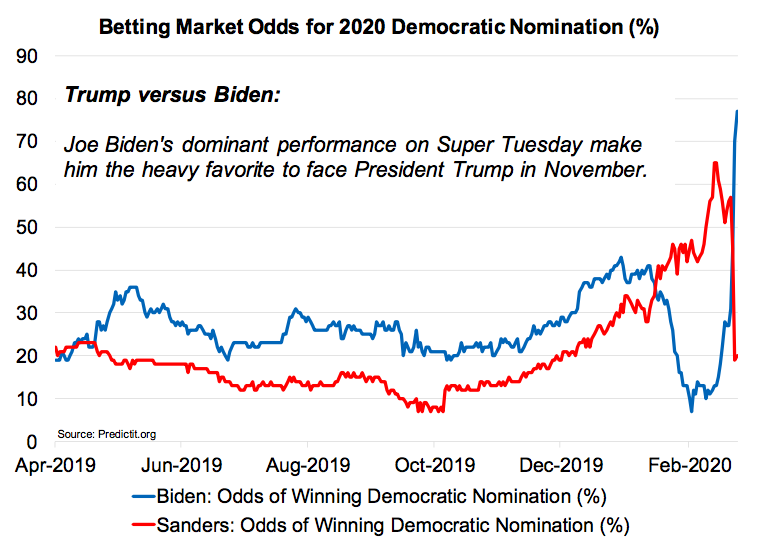
Meanwhile, the betting market on the Democratic presidential nominee is almost as erratic as stocks are these days. Today, the morning after the Super Tuesday primaries, Predictit bettors are giving Joe Biden a 77% chance of winning the nomination. Bernie Sanders’s chances have plummeted to 20%; a huge collapse from 60+% last month. It appears the turning point for Biden was his resounding win in the South Carolina primary as well as big surprise victories in Texas, Massachusetts and Minnesota. Clearly, the endorsements by Peter Buttigieg and Amy Klobuchar prior to Super Tuesday helped consolidate the moderate Democratic vote behind Biden; while Elizabeth Warren’s decision to stay in the race split the progressive vote from Sanders. Given how deeply divided the Democratic Party has been between moderates and progressives, perhaps the obvious path to build a bridge between both wings would be a Biden-Warren ticket. Predicit betting markets, however, have Kamala Harris as the current odds-on favorite to win the VP nomination at 20%, with Warren at 12%.

PKH Headshot - Sep 2015.jpg

Paul Hoffmeister is chief economist and portfolio manager at Camelot Portfolios, managing partner of Camelot Event-Driven Advisors, and co-portfolio manager of  Camelot Event-Driven Fund  (tickers: EVDIX, EVDAX).

*******

Disclosures:

•       Past performance may not be indicative of future results. Therefore, no current or prospective client should assume that the future performance of any specific investment, investment strategy (including the investments and/or investment strategies recommended by the adviser), will be profitable or equal to past performance levels.

•       This material is intended to be educational in nature, and not as a recommendation of any particular strategy, approach, product or concept for any particular advisor or client.  These materials are not intended as any form of substitute for individualized investment advice.  The discussion is general in nature, and therefore not intended to recommend or endorse any asset class, security, or technical aspect of any security for the purpose of allowing a reader to use the approach on their own.  Before participating in any investment program or making any investment, clients as well as all other readers are encouraged to consult with their own professional advisers, including investment advisers and tax advisors.  Camelot Portfolios LLC can assist in determining a suitable investment approach for a given individual, which may or may not closely resemble the strategies outlined herein.

•       Any charts, graphs, or visual aids presented herein are intended to demonstrate concepts more fully discussed in the text of this brochure, and which cannot be fully explained without the assistance of a professional from Camelot Portfolios LLC.  Readers should not in any way interpret these visual aids as a device with which to ascertain investment decisions or an investment approach.  Only your professional adviser should interpret this information.

Some information in this presentation is gleaned from third party sources, and while believed to be reliable, is not independently verified


[i] “Coronavirus: Italy reports 7 dead, 229 infected as Europe braces for COVID-19,” February 24, 2020, CNBC.

[ii] Ibid.

[iii] Ibid.

[iv] “Top CDC official tells Congress coronavirus almost qualifies as a global pandemic,” by Berkeley Lovelace Jr., March 3, 2020, CNBC.

[v] Ibid.

[vi] “In U.S. and Germany, Community Transmission Is Now Suspected,” February 26, 2020, New York Times.

[vii] “U.S. Coronavirus Infections Rise as Cases Outside China Pass 10,000,” by Jennifer Calfas and Jing Yang, March 3, 2020, Wall Street Journal.

[viii] “Europe ‘panicking’ over India’s pharmaceutical export curbs: industry group,” by Neha Dasgupta and Ludwig Burger, March 4, 2020, Reuters.

Coronavirus & Sanders: Jolt of Uncertainty

By Paul Hoffmeister


CoronaVirus: All about Treatment and Containment

The market outlook became much cloudier in late January due to the uncertainty caused by the Coronavirus outbreak and the recent surge by Bernie Sanders.

To paraphrase Frank Knight, the early 20th century University of Chicago economist, “risk” applies to situations where we do not know the outcomes but can reasonably measure the odds; whereas “uncertainty” applies to situations where we simply do not have sufficient information to confidently measure the odds.

Within this framework, one can easily argue that the Coronavirus epidemic in China created a textbook case of uncertainty. Where did the virus come from? How deadly would it be? And, how far would it spread?  

On January 23, 2020 Chinese authorities expanded travel restrictions imposed on the city of Wuhan to surrounding municipalities, shut down travel networks, and attempted to quarantine 25 million people.[i] What was considered by many as an epidemic localized in Wuhan suddenly became a potential global pandemic, evoking memories of SARS and Ebola.

As of the time of this writing, Johns Hopkins estimates that more than 20,000 people have been infected in 27 countries, with 427 dead. And according to CNBC, at least 24 Chinese provinces, municipalities and regions have told businesses not to resume work until February 10.[ii] This shutdown in Chinese production is huge, as these parts of the country account for more than 80% of China’s GDP.[iii]

One can see that accurately measuring the consequences of the Coronavirus – in terms of human and economic costs – can be exceedingly difficult, especially if the virus were to spread much more. Therefore, it’s not surprising that January 23rd, when this relatively contained epidemic seemed to begin morphing into a potential global pandemic, marked the recent peak in the S&P 500. On a closing basis, the S&P 500 traded at 3325.54 on Thursday January 23, and fell 3% to a low of 3225.52 on Friday January 31.[iv] 

Screen Shot 2020-02-07 at 11.20.35 AM.png

For some context for thinking about the market impact of a major, deadly viral outbreak, we estimate that the SARS and Ebola episodes in 2003 and 2004, respectively, led to approximately 5% to 11% selloffs in the S&P 500.

Screen Shot 2020-02-07 at 11.20.51 AM.png

The histories of the SARS and Ebola outbreaks as well as what we’re currently seeing with the Coronavirus suggest that the key questions for markets are: will the respective outbreak be relatively contained, and will the symptoms be mostly treatable? In the Knightian sense, concrete answers to these questions can transform highly immeasurable “uncertainty” into much more quantifiable “risk”. And that may be what we have been seeing recently.

While the human and economic costs of the Coronavirus have been massive, recent information offer some hope that this crisis will be contained.

First, effective treatment strategies may be on the way. For example, in Thailand, doctors have reported success in treating severe cases with a combination of anti-flu and anti-HIV medications.[v] Thailand’s health ministry has reported that a previously positive testing 71-year old patient tested negative for the virus after starting the combination.[vi] This news appeared to break on Sunday February 2, and in our view, may have been the key factor behind the strength in the S&P 500 beginning the next day. Then, on February 5, Sky News reported that a British scientist made a breakthrough in the race for a vaccine, which could reduce the development time from two to three years to just 14 days.[vii] The news appeared to further support the strength in equities this week.

Secondly, measures to contain the outbreak have been drastic. As most of us have seen, travel into and out of Hubei province has mostly stopped, and travel into and out of China has been significantly restricted. This may be the world’s largest quarantine in history. Additionally, the New York Times has reported that Chinese officials are utilizing the country’s vast surveillance network to track down infected citizens, as well as those that may have been near them; and even offering bounties of 1,000 yuan for each infected Wuhan person reported by residents.[viii] [ix] Leaving democratic and privacy principles aside, it’s possible that these extreme measures may be what financial markets want to see as far as containment is concerned.

While it took months for the SARS and Ebola outbreaks to get under control, and this will likely be the case with the Coronavirus, the improving outlook for treatment and containment should encourage financial markets going forward. We will almost certainly see infection counts and death tolls continue to rise during the near-term. But as long as treatment and containment continue to be effective, the rates of infection and death should ultimately crest.

The Bernie Rally 

The political market is increasingly eventful these days, and should be so as the primetime of the Democratic primaries happens during the next 60 days.

The big news is: Mayor Peter Buttigieg surprised many with his victory-by-a-nose in the Iowa Caucus, and former Vice President Joe Biden’s prospects to secure the nomination have plummeted. According to the Predictit betting market, Biden was being priced on January 8, at a 43% probability to win the Democratic presidential nomination. As of February 4, he traded at 20%.

But the biggest news in the political arena is the ascension of Bernie Sanders to front-runner status. Between January 8 and February 4, his odds on Predictit of securing the nomination jumped from 32% to 39%, with a high of 46% on February 2.

Screen Shot 2020-02-07 at 11.21.08 AM.png

Interestingly, the Bernie Rally seemed to ignite on January 24, after popular podcast host and UFC commentator Joe Rogan said on his podcast that he will “probably” vote for Sanders, after having interviewed him months ago.[x] The next day, Bernie’s Predictit odds jumped to a new high of 38% (from 34% on January 24), and his odds haven’t closed below 38% since. According to Slate, Rogan’s podcast was Apple Podcasts’ second most downloaded podcast in 2017 and 2018.[xi] Without a doubt, the landscape of political news and influencers has dramatically changed in recent years. 

The next two months may very well decide the Democratic nominee. New Hampshire is February 11, Nevada February 22, and South Carolina February 29. According to Predictit, the front-runners in each are, respectively, Sanders (at 83%), Sanders (66%), and Biden (60%).

Then “Super Tuesday” takes place on March 3, when nearly a third of all delegates are awarded; of which the biggest prizes are California and Texas with 415 and 228 delegates, respectively.[xii] Currently, Sanders is the front-runner in both states in the Predictit market.

January may turn out to be a major inflection point in the Democratic political market for the White House, with Sanders’s ascension and Biden’s plunge.

The consensus appears to be that President Trump is extremely pro-stock market, while Sanders may be the polar opposite. But what sectors will be most at-risk should Sanders win the general election in November? As we see it, Sanders could be especially negative for private prisons, gun manufacturers, student loan services, healthcare, private equity, and industries that benefit from a low minimum wage such as retail, leisure and hospitality.

We’ll likely see some movement or discounting in the stocks of these sectors during the coming months, especially if Sanders’s momentum continues. But, of course, one cannot easily assume Bernie Sanders will be president in 2021. Predictit is currently pricing in a 54% probability of a Republican winning in November; with Republicans likely keeping the Senate, and Democrats the House.

Paul Hoffmeister, Chief Economist, Camelot Portfolios, LLC

Paul Hoffmeister is chief economist and portfolio manager at Camelot Portfolios, managing partner of Camelot Event-Driven Advisors, and co-portfolio manager of Camelot Event-Driven Fund  (tickers: EVDIX, EVDAX).

*******


Disclosures:

•       Past performance may not be indicative of future results. Therefore, no current or prospective client should assume that the future performance of any specific investment, investment strategy (including the investments and/or investment strategies recommended by the adviser), will be profitable or equal to past performance levels.

•       This material is intended to be educational in nature, and not as a recommendation of any particular strategy, approach, product or concept for any particular advisor or client.  These materials are not intended as any form of substitute for individualized investment advice.  The discussion is general in nature, and therefore not intended to recommend or endorse any asset class, security, or technical aspect of any security for the purpose of allowing a reader to use the approach on their own.  Before participating in any investment program or making any investment, clients as well as all other readers are encouraged to consult with their own professional advisers, including investment advisers and tax advisors.  Camelot Portfolios LLC can assist in determining a suitable investment approach for a given individual, which may or may not closely resemble the strategies outlined herein.

•       Any charts, graphs, or visual aids presented herein are intended to demonstrate concepts more fully discussed in the text of this brochure, and which cannot be fully explained without the assistance of a professional from Camelot Portfolios LLC.  Readers should not in any way interpret these visual aids as a device with which to ascertain investment decisions or an investment approach.  Only your professional adviser should interpret this information.

•       Some information in this presentation is gleaned from third party sources, and while believed to be reliable, is not independently verified.

[i] “Chinese cities cancel New Year celebrations, travel ban widens in effort to stop coronavirus outbreak,” by Anna Fifield and Lean Sun, January 23, 2020, Washington Post.

[ii] “More than half of China extends shutdown over virus,” By Eveyln Chang, February 1, 2020, CNBC.

[iii] Ibid.

[iv] Source: Yahoo Finance.

[v] “Cocktail of flu, HIV drugs appears to help fight coronavirus: Thai doctors,” by Panu Wongcha-um, February 3, 2020, Reuters.

[vi] “Thailand Says New Drug Cocktail Successfully Treated Coronavirus in Chinese Patient in 48 Hours,” February 3, 2020, News18.com.

[vii] “British scientist makes breakthrough in race for coronavirus vaccine,” February 5, 2020, Reuters.

[viii] “China, Desperate to Stop Coronavirus, Turns Neighbor Against Neighbor,” by Paul Mozur, February 3, 2020, New York Times.

[ix] “China Sacrifices a Province to Save the World from Coronavirus,” by Claire Che, Dandan Li, Dong Lyu, Rachel Chang and Iain Marlow, February 4, 2020, Bloomberg News.

[x] “Podcast host Joe Rogan endorses Bernie Sanders,” January 24, 2020, Yahoo Finance.

[xi] “Joe Rogan’s Galaxy Brain,” by Justin Peters, March 21, 2019, Slate.

[xii] Source: New York Times