
by Paul Hoffmeister, Portfolio Manager and Chief Economist
On October 14, during our Camelot Advisor Series, we presented our thoughts about the AI buildout, its trajectory, and implications for financial markets and the economy. Arguably, artificial intelligence is one of the most significant technological breakthroughs in American history, and it’s underpinned by one of its largest capital investment booms. According to the U.S. Bureau of Economic Analysis, private fixed investment in information processing equipment and software grew nearly 20% year-over-year in Q2 2026 and exceeded more than $1.6 trillion annualized. This historic investment has arguably propelled the U.S. economy in recent years and possibly prevented it from going into recession – despite many macroeconomic and financial indicators (e.g. the yield curve and Leading Economic Indicators) seemingly flashing warning signs in 2023 and 2024 of a looming recession.
As we see it, the excitement about the technological innovations, their potential, and the possibility of investment “exuberance” within financial markets has led to some AI-related investment concentration in the S&P 500 and other equity indices, and to a certain degree in investment grade bond indices. We believe that we’re entering a phase in this technology cycle where revenues will need to live up to expectations. At the same time, higher interest rates and a Fed leaning toward further tightening are adding additional layers of risk to markets and the economy. We believe there is significant risk inherent to the high expectations that some have about future investment returns.
It’s possible that even if AI technology succeeds and produces incredible products and services, AI investments may disappoint investors -- similar to how investments disappointed during the railroad and fiber buildouts. As we monitor the direction of the economy and financial markets during this unusual economic and technological period, some of the things that we’re watching especially closely are equity and credit prices, quarterly company commentaries regarding earnings and capex outlooks, and exogenous risks such as rising interest rates and energy costs.
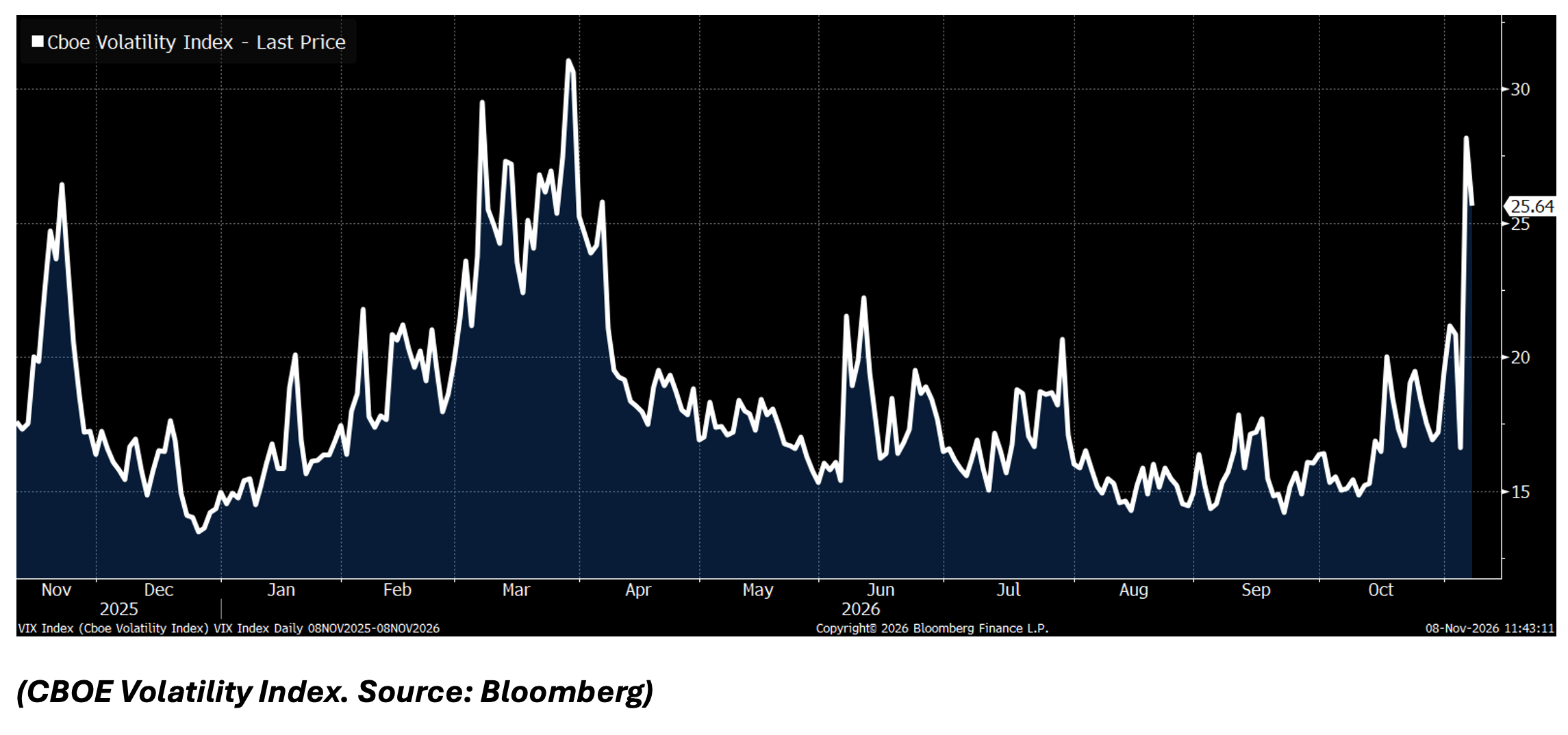
In recent weeks, market volatility has erupted to levels last seen during the stock market weakness in late March 2026. The VIX Index exceeded 28 last week (on a closing basis), the first time since the end of the first quarter. Notably, the Philadelphia Semiconductor Index declined by nearly 25% and the UBS Hyperscalers Index by approximately 10% from their October highs. These significant drawdowns and the seemingly widespread debate over whether the stock market is in a “tech bubble” raise the question: is this the beginning of an investment bubble bursting, if one exists?
From our perspective, equity markets are thus far giving a warning, but not a verdict; and credit markets are flashing selectively, rather than broadly.
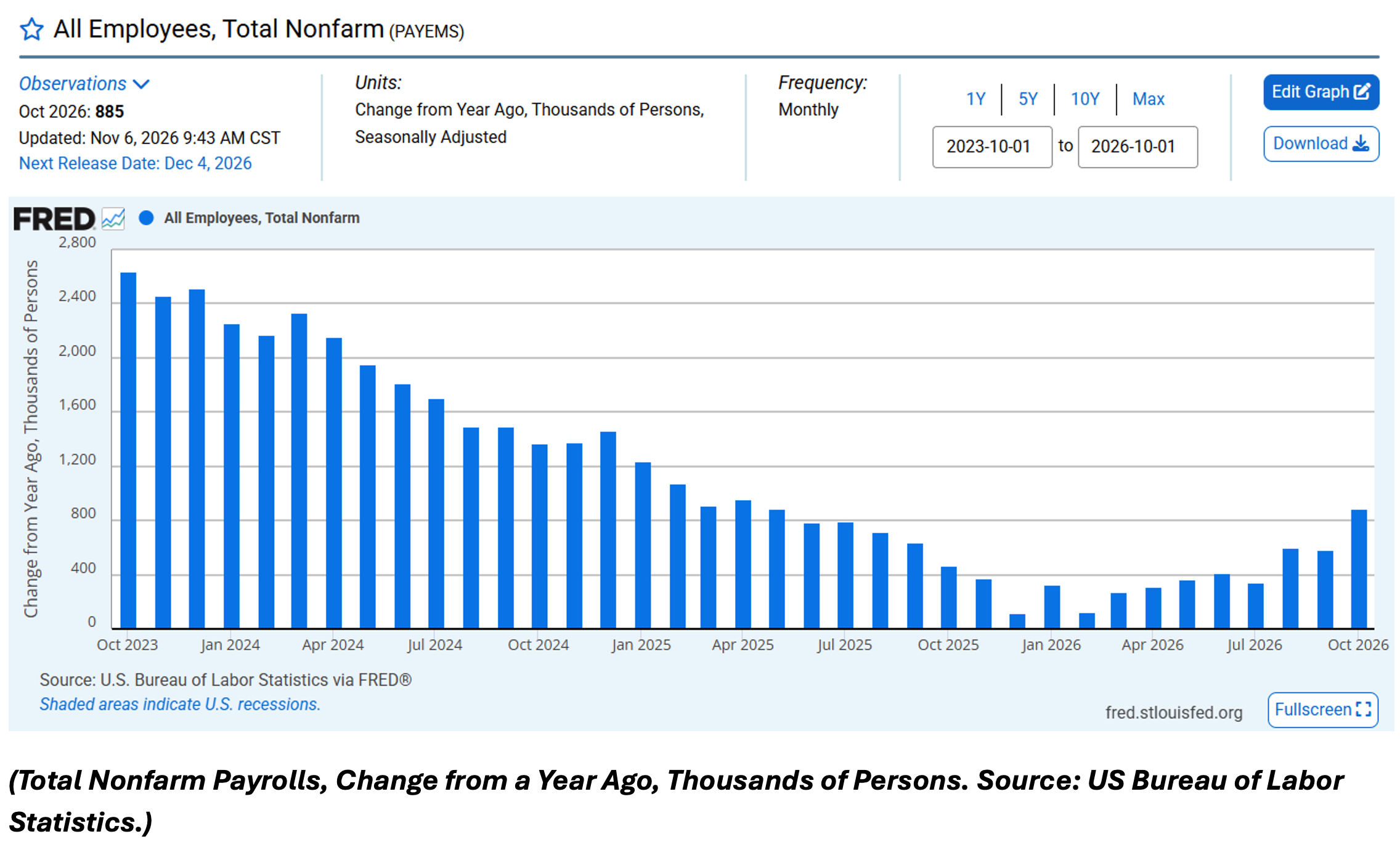
At the moment, it doesn’t appear to us that the economy is about to weaken and that technology spending is about to stall -- at least for now. Our impression from hyperscaler quarterly reports in recent weeks is that the strong trend in capital expenditures is not yet set for a major slowdown. Recent payroll figures indicated strong economic and job market conditions. And, we have not yet seen a dramatic, nor broad deterioration in credit conditions.
Instead, we believe that the recent market volatility is related to rate and policy repricing, layered on funding questions. Specifically, markets appear to be grappling with new information related to another quarter-point rate increase by the FOMC in December and political uncertainty, including concern that data center buildouts will slow following the midterm results.
Two FOMC members dissented against the Committee’s decision to keep rates unchanged, preferring to raise the target range by a quarter point. And earlier this week, Federal Reserve Governor Christopher Waller suggested that he might favor a 50 basis point increase if inflation data came in relatively high. According to the CME Fed Watch, markets are currently implying an 89% probability of a quarter-point rate increase on December 9.
Furthermore, in Texas, Governor Abbott ordered a pause in September on new data center environmental permits until audits were completed. But even more, Governor-elect Gina Hinojosa, who assumes office in January, had campaigned promising to impose a moratorium on data centers until the state legislature enacts a range of social and labor considerations related to their construction. According to Business Insider, Texas has the second most operational data centers in the country, behind Virginia. This is one example of new regulatory considerations and risks that markets may need to discount in the coming months.
Nonetheless, market volatility and equity and credit weakness, if they persist, are important signals to us. Capex can be committed years ahead, so spending data can lag. Market prices, however, can move before the real economy does. Data that reassure us are the data that can move late in a cycle, which is why we weight prices heavily.
The order of signals right now that we’re watching are what we deem to be the weakest links in equity and credit, equity leadership (particularly from semiconductor and hyperscaler companies), capex guidance, and ultimately hard data such as GDP, payrolls, and earnings. We don’t yet see a negative chain reaction. However, we would turn more cautious on the economy at large if the technology sector were to notably underperform the broad equity market and were this to be confirmed by a broad-based credit market weakness such as persistently widening credit spreads.

Paul Hoffmeister is Chief Economist and Portfolio Manager at Camelot Portfolios, managing partner of Camelot Event-Driven Advisors (CEDA), and co-portfolio manager of the Camelot Event-Driven Fund (EVDIX • EVDAX).
WANT MORE WAYS TO STAY UP-TO-DATE
ON ALL THE EVENT-DRIVEN NEWS?
Camelot Event-Driven Advisors LLC | 1700 Woodlands Drive | Maumee, OH 43537 // B787
All investing carries with it risk, including the risk of loss, that investors should be prepared to bear. This material is for educational use only and is not intended to be construed as investment advice. Readers or participants in an oral presentation of these materials should consult with their own personal financial, tax, legal and other advisors before making any decision to make any investment, including any investment believed to be related to the topics of these materials. The discussion herein, while based on current economic data, may or may not lead to the outcomes presented, express or implied. Economic conditions, even in a single sector, are subject to an unknown number of variables, the totality of which are impossible to predict or account for in analytical assumptions. Past performance does not necessarily lead to future results. Specifically, trends in economic data do not always, and frequently do not, continue as expected.
Copyright © 2026 Camelot Event-Driven Advisors LLC, All rights reserved.
Copyright © 2026 Camelot Portfolios LLC, All rights reserved.