
by Paul Hoffmeister, Portfolio Manager and Chief Economist
The inversion of the U.S. Treasury yield curve has long been regarded by economists and financial market participants as one of the more reliable leading indicators of recession. According to data from the Federal Reserve Bank of St. Louis, every sustained inversion over the past four decades (including those preceding the recessions of the early 1990s, the dot-com bust, the Global Financial Crisis, and the brief pandemic recession) was eventually followed by a meaningful economic downturn. When the 10-year Treasury yield fell below the 3-month Treasury bill rate in late 2022, it appeared that history was about to repeat itself. Yet, as of today, a recession hasn’t materialized.
The yield curve remained inverted for almost 25 months, the longest sustained inversion since at least 1970. But instead of slipping into recession, the U.S. economy delivered in our view one of the most surprising outcomes in modern macroeconomic history by continuing to expand despite what was arguably the most aggressive monetary tightening cycle in decades.
While no single factor can fully explain the economy's surprising resilience, we believe one of the most compelling explanations is the surge in technology investment, driven largely by artificial intelligence. Rather than experiencing the broad-based weakness typically associated with the restrictive monetary policy of the “Powell Fed” between 2022 and 2024, the United States entered one of the largest technology capital spending cycles in decades. In our view, this wave of investment did more than simply support economic growth; it may have altered the normal transmission mechanism through which tighter monetary policy affected the broader economy.
According to the Bureau of Economic Analysis (BEA), private fixed investment in information processing equipment and software reached an annualized $1.56 trillion during the first quarter of 2026. That was not only the highest level of spending ever recorded, but more than $600 billion above the annualized spending level recorded in 2023. This was not simply a continuation of a long-term trend; rather, it represented a dramatic upward shift in the pace of business investment.
The speed of the expansion is equally impressive. According to the BEA, technology investment grew 18.7% year-over-year in the first quarter of 2026, among the strongest readings since the late-1990s technology boom. Moreover, growth exceeded 13% for five consecutive quarters, a sustained pace that had not been seen outside the dot-com era. Such figures suggest that businesses are no longer making incremental upgrades to their technology infrastructure. Instead, they’re undertaking what appears to be a once-in-a-generation buildout of computing capacity to support artificial intelligence.
Importantly, this spending has been highly concentrated. According to Pimco, annual capital expenditures among the major hyperscale cloud infrastructure providers are expected to increase from roughly $234 billion in 2024 to an estimated $688 billion and $870 billion by 2026 and 2027, respectively. [1]
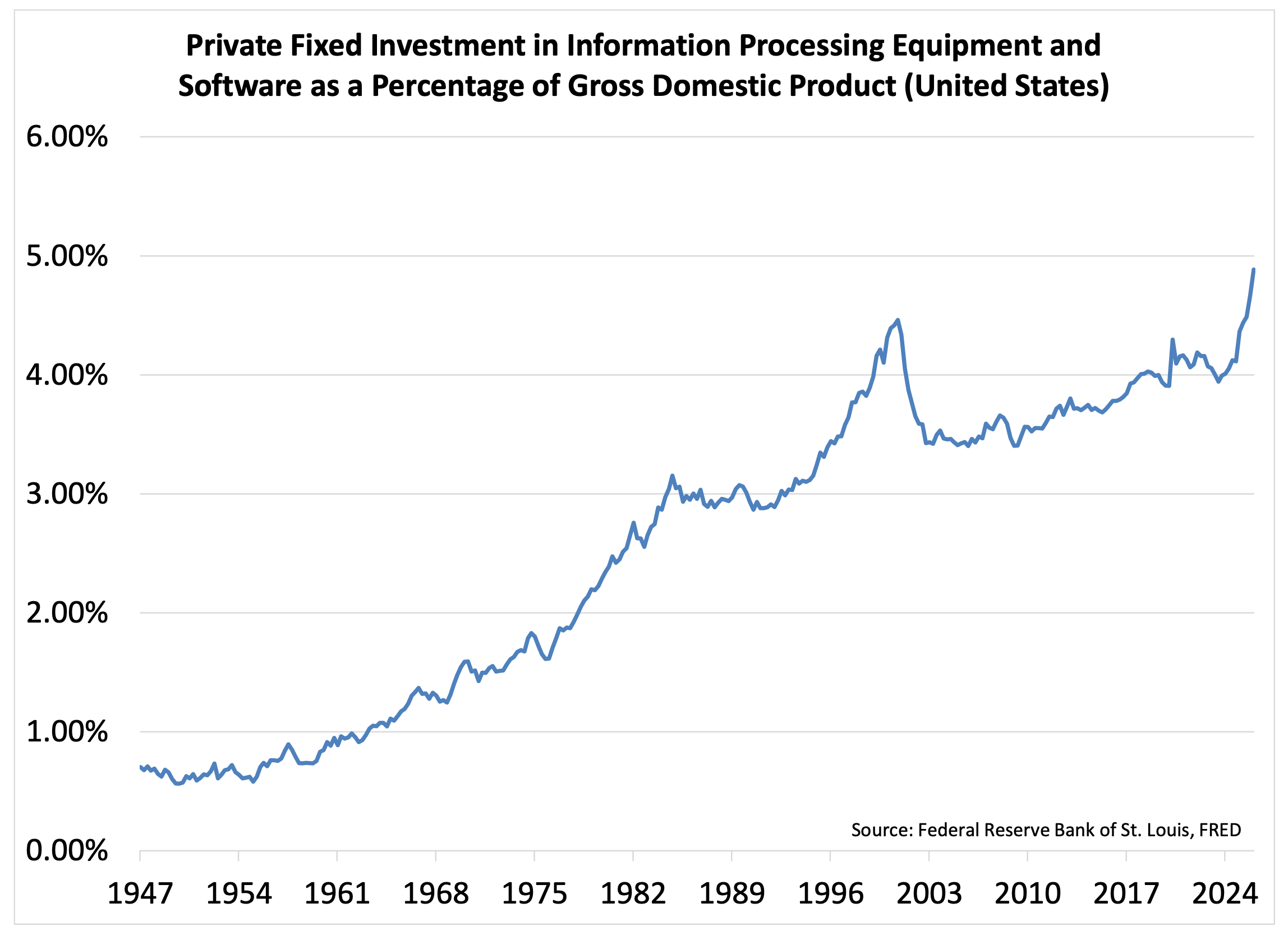
This investment surge has had meaningful macroeconomic consequences. According to the BEA, business investment is one of the principal components of gross domestic product, and the recent increase in technology spending has contributed directly to economic growth. Information processing equipment, software, and related investment now account for approximately 4.9% of U.S. GDP, the highest share on record and above even the peak reached during the dot-com era. [2]
Hannah Rubinton and Bontu Ankit Patro from the Federal Reserve Bank of St. Louis state that AI-related investment has recently “surpassed the contribution of IT components to the real GDP growth made during the dot-com boom, both in level and as a share of GDP.” [3] Their analysis suggests that information technology or AI-related investment contributed 0.97 percentage points to real GDP growth during the first three quarters of 2025, compared to 0.81 percentage points in 2000. They add: “Through the third quarter of 2025, these categories made up 39% (36% excluding data centers) of total GDP growth versus 28% in 2000.”
This may help to explain why the economy proved more resilient than traditional recession models predicted. According to Federal Reserve and Bureau of Economic Analysis data, higher interest rates slowed housing activity, constrained commercial real estate, and reduced interest-sensitive consumer spending. Under normal circumstances, those forces would likely have produced a recession. Instead, an unprecedented wave of technology investment generated new demand for construction, electrical equipment, industrial machinery, semiconductors, networking hardware, engineering services, software, and highly skilled labor. Arguably, the multiplier effects extended well beyond Silicon Valley, supporting manufacturing facilities, utilities, supply chains, and employment across numerous industries. In sum, the sectors of the economy that are normally most sensitive to higher interest rates were arguably offset by an equally extraordinary surge in business investment, delaying or fundamentally reshaping the traditional path from monetary tightening to recession.
At the same time, important questions remain about the durability of this investment cycle. According to PIMCO, the financing mix is gradually shifting from internally generated cash toward debt issuance and private financing vehicles. This may increase financial risk if credit conditions tighten. More fundamentally, while companies continue to invest aggressively, measurable returns from generative AI remain uncertain. Furthermore, research last year from MIT's NANDA initiative reported that approximately 95% of organizations had yet to demonstrate measurable returns on their generative AI initiatives. [4]
Nevertheless, the evidence increasingly suggests that the recent AI investment boom has done more than provide a temporary boost to economic activity. It may have fundamentally altered the way restrictive monetary policy has been transmitted through the U.S. economy. The yield curve may not have failed as a recession indicator. Instead, a concentrated wave of AI-related capital investment may have temporarily overwhelmed the cyclical forces that have historically followed prolonged yield curve inversions. If that interpretation proves correct, the past several years may represent not merely an historical exception, but the beginning of a new chapter in which transformative technological investment can meaningfully reshape the business cycle itself. Whether that ultimately reflects the emergence of a sustained productivity revolution, or simply another investment boom whose returns eventually disappoint, will likely become one of the defining macroeconomic questions of this decade.
__________
[1] “AI Credit Expansion: Assessing the Micro and Macro Risks”, By Lotfi Karoui, Michael Puempel and Amit Arora, Pimco, May 22, 2026.
[2] Source: U.S. Bureau of Economic Analysis, FRED.
[3] “Tracking AI’s Contribution to GDP Growth”, Hannah Rubinton and Bontu Ankit Patro, Federal Reserve Bank of St. Louis, January 12, 2026.
[4] “MIT report: 95% of generative AI pilots at companies are failing”, by Sheryl Estrada, Fortune, August 18, 2025.

Paul Hoffmeister is Chief Economist and Portfolio Manager at Camelot Portfolios, managing partner of Camelot Event-Driven Advisors (CEDA), and co-portfolio manager of the Camelot Event-Driven Fund (EVDIX • EVDAX).
WANT MORE WAYS TO STAY UP-TO-DATE
ON ALL THE EVENT-DRIVEN NEWS?
FOLLOW US ON LINKEDIN!
VISIT OUR FRIENDS AT EVENT-DRIVEN.BLOG
Camelot Event-Driven Advisors LLC | 1700 Woodlands Drive | Maumee, OH 43537
All investing carries with it risk, including the risk of loss, that investors should be prepared to bear. This material is for educational use only and is not intended to be construed as investment advice. Readers or participants in an oral presentation of these materials should consult with their own personal financial, tax, legal and other advisors before making any decision to make any investment, including any investment believed to be related to the topics of these materials. The discussion herein, while based on current economic data, may or may not lead to the outcomes presented, express or implied. Economic conditions, even in a single sector, are subject to an unknown number of variables, the totality of which are impossible to predict or account for in analytical assumptions. Past performance does not necessarily lead to future results. Specifically, trends in economic data do not always, and frequently do not, continue as expected. B750
Copyright © 2026 Camelot Event-Driven Advisors LLC, All rights reserved.
Copyright © 2026 Camelot Portfolios LLC, All rights reserved.